Sunday, November 24, 2013

November 24: Following (1998 -- Christopher Nolan)

★★★★

This is a surprisingly fun little film, enjoyable in its own right and and a pleasure to see from our vantage point now much further into Nolan’s career. The director’s first outing, Following is a film shot in black-and-white and complete with a dark mood, pervasive corruption, high-key lighting and a femme fatale in the person of the Blonde.  It also borrows the trope of starting with a cop interrogating our main character, and as is often the case in this genre, the hero doesn't fare well in the film.  It’s easy to see Following’s film noir roots.

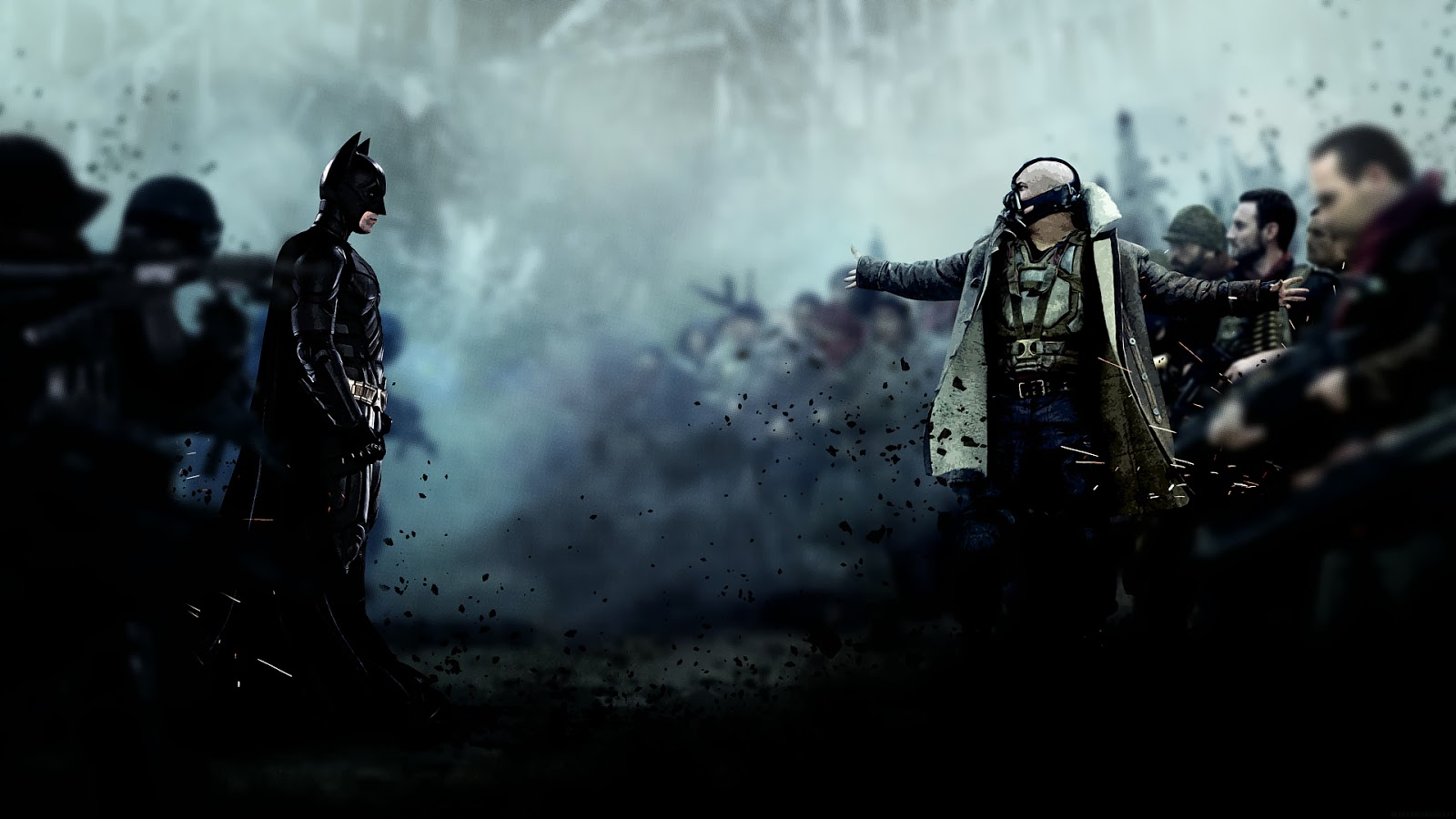
None of this is very far from The Dark Knight Rises.  Not completely black-and-white, the later film is nonetheless often monochrome, and there’s clearly the same oppressive dark mood in both, even heightened in Following.  There’s also a fair amount of darkness and contrast lighting in Dark Knight Rises, and it has both a penitent and a full-blown femme fatale in Catwoman and Miranda Tate, respectively.  The correspondences are uncanny; without seeing Following, I wouldn't have picked up on the film noir elements in The Dark Knight Rises.

Yet watching Following is more fun than watching Nolan’s latest Batman.  Following is taunt and its elements, purposeful; in fact, in the reversal at the end of the film, the viewer even reinterprets all that has come before.  Something as insignificant as signing a credit card turns out to have been important to the story, unlike the rambling in Dark Knight Rises that can dwell on elements that don’t resonate later.  Why did Bruce Wayne spend all that time in an underground prison?  There is no such sprawl in Following.  This film is economical rather than sprawling and fat; every detail, item and even gesture has purpose.

This movie also has narrative engagement and suspense, two things lacking in The Dark Knight Rises.  Nolan’s fractures the plot of Following into four periods and intercuts them for the story, but there are always clear markers to cue the viewer into the respective parts of the plot.  We find ourselves watching the film as something of a puzzle, but this story structure also engages us with questions about how these parts are connected.  Why did the Young Man get cleaned up?  How did he end up with the bruises?  This type of narrative is somewhat contrived, and though Nolan uses it just as effectively in the later Memento, it’s not technique that would bear frequent repetition.  Here, though, it pulls us into the story.

And Following has lots of squirm-inducing suspense.  The film’s basic concept of following a stranger for fun is creepy and raises fear in the audience of the consequences; the tense scene when Cobb confronts the Young Man gets its suspense from this setup.  There’s also an extremely suspenseful scene when the two break into an apartment and Cobb casually goes through the residents’ personal items, even having a glass of wine in their kitchen.  That suspense peaks when one of the residents returns home unexpectedly.  And in yet another scene, the Young Man has to tape cash to his body while in constant fear of being caught.  That scene is has an intensity lacking at any individual point in The Dark Knight Rises.

Following has originality, creativity, engagement and suspense.  Darkness pervades this little movie, but it’s a sharp, cutting darkness rather than the continuing thud of a club.  This debut makes us hope that Nolan is eventually able to make contact again with the deftness and precision of this early work.


Sunday, November 17, 2013

November 17: The Dark Knight Rises (2013 -- Christopher Nolan)

★★

If Dostoyevsky worked for Stan Lee, we’d get something like The Dark Night Rises.  An aging, battered Bruce Wayne opens the film in seclusion, licking his wounds.  Gotham crime rebounds, and Wayne goes through mental angst to decide if he should don the cape anew.  One he decides, and with the aid of a remarkable brace, he recovers his physical agility.  However, he is soon betrayed by the woman he loves (twice), loses his entire fortune, and gets badly beaten yet again by Bane, who exiles him to an underground prison in China (or someplace similar).  By comparison, Raskolnikov didn’t have much to deal with.  And into this unrelenting stream of pain, is added the infirmity of Commissioner Gordon and the fall of Gotham City into a sort of Reign of Terror with its own Robespierre. 

Then Batman defeats the bad guys and goes to Florence for coffee with his repentant girlfriend.  I kid you not.

The Dark Night Rises is a sprawl of cinema that veers from one mood to another and from one plot point to another.  First, Batman is crushed, but comes back to win the second round.  He’s imprisoned with little explanation, and he gets back to Gotham with little explanation.  To a degree, this aesthetic is true to the Marvel source, but on the screen, it becomes long and even annoying.  And Nolan isn’t inclined to pare his story down to a more fundamental narrative focus with consistent characters and values.  When we discover that Bane isn’t the real bad guy but that Talia is, this reveal nearly takes the wind out of the story; we lose Bane’s plot energy, but Talia doesn’t have the story interest to replace him. In the first 90% of the film, Batman undergoes so much pain and loss that we might be forgiven if we eventually wish he would indeed give up the cowl so his relentless pain would ease.

But for all these unsatisfying elements of The Dark Knight Rises, there are aspects of the film that warrant note.  One of the most interesting is that Batman is a past-his-prime male who has to try to find his place in the world outside the role he’s held for so long. Dark Knight Rises gives us a superhero that isn’t as super as he used to be, who is physically vulnerable and who can be tricked.  He’s a superhero we don’t see often.  Dark Knight Rises also makes a political nod in the direction of today’s situation of a shrinking middle class and an underclass with no upward mobility.  Catwoman resents the rich in an almost Robin Hood way, and Bane’s takeover of Gotham appeals to resentment against the 10%.  But if Dark Knight Rises has a political message, it’s difficult to read it clearly.  There’s a position here against Tea Party anarchy, but there’s also a feeling that Bruce Wayne and the moneyed class manage to keep order much better than the mob rule Bane incit and manipulates.  The ideology here isn’t clear, or it’s one that many of us might not want to think about.

As with the other two installments of Batman -- and many of his other films – Nolan goes for gut moments at the expense of the overall film.  Dark Knight Rises isn’t nearly as rambling and fractured as its immediate predecessor, but it’s not a very satisfying either.


Saturday, November 16, 2013

November 16: Looper (2013--Rian Johnson)

★★★

Looper is the little sci-fi movie I’ve been wanting to see all year.  It doesn’t have grandiose ambition but instead takes a single conceit and works it into a clever, engaging two-hour cinema experience that teaseses the sci-fi-minded to daydream what-ifs. 

The strength here is Rian Johnson’s screenplay, as artful and precise as a music box.  In the future, if a criminal guy does't like someone, they send that person back in time, where execution awaits at the hands of a Looper, a killer who gone back in time to do this work.  However, Loopers must eventually kill their older selves, and sometimes this rule causes problems.  When Young Seth refuses to kill Old Seth, gang members capture the younger boy and carve an address into his arm which then shows up as a scar on the arm of the Old Seth, summoning the older man to his death.  It’s a grim scene as Old Seth experiences broken bones and missing appendages as he tries to get to the address, but it’s perfectly part of the time travel logic of Johnson’s music box.  The present affects the future, so when Old Joe starts to lose a clear idea of his (future) wife, an astute viewer will pick that up as foreshadowing about something that will happen in the future.

In addition to the time travel conceit that Johnson manages so adroitly, Looper putters right along with suspense from several sources.  What’s the gang going to do to the two Joes?  Will Old Joe be able to save his wife….and the same question: Will he kill the Rainmaker before the latter becomes a crime monster of the future?  And since we’ve already seen that the present affects the future, what will the future look like after Young and Old Joe have had their climatic encounter?  All these narrative questions keep you plugged into this fun, smart sci-fi movie.

Looper isn’t deep, intellectual sci-fi, but it’s smart and well-crafted.  And it even manages character development and passing cinematography along the way.  This is a worthwhile film to catch on a day when you feel like a ration of cinematic precision.

Friday, November 15, 2013

November 15: Oblivion (2013 -- Joseph Kosinski)

★★★

Bad notices aside, I enjoyed this film.  Visuals count, and there’s a lot of pleasure to be had from soaking up what’s on the screen.  From the clean look of the sky home where Jack and Vika live to NYC ruins like the public library and the Empire State Building, there’s most always something worth looking at in Oblivion.  Desolate scenes are empty, and panoramas have expanse, even when there’s a monster of a mechanism looming far away.  The movie also has an engaging tone of Romantic nostalgia for a lost civilization, similar to that in WALL-E, with Jack Harper as the last man on earth, left to maintain a few machines, sift through damaged artifacts of the lost culture, and engage his fantasies of what life must have been like.  All this makes for a good sci-fi movie, and if there’s the occasional Star Wars-inspired chase through a narrow canyon or struggle with a sophisticated version of Hal, so much the better.

There’s even enough suspense to hold our attention as we go through a series of surprises.  We discover, for example, that our Moon-inspired maintenance man has an little refuge in an area of rich greenery, and soon afterwards, we face the mystery of why the Scavs want to capture Jack rather than eliminate him in the library scene.  And before we linger on that point too long, a signal mysteriously comes from the Empire State ruins, a ship with a human crew lands, drones attack the crew, and Jack and a new character, Julia, end up with the Scavs.  The story continues to move quickly all the way through the big clone reveal, another salute to Moon, and on to the counter-attack against the Tet.  I enjoyed the ongoing narrative springs through the film.

Oblivion even gives us something of a sci-fi thematic question in the second part of the film: What does identity consist of?  In all the film’s loss and nostalgia, we discover that Jack 49 looks exactly like his clone, Jack 52, so 52 would logically have the same memories as 49;  however, memory scrub aside, it’s by no means clear that they share the dreams of their wife, Julia, or that both have their wilderness homestead.  With this same-but-different twist, the plot gets a little unstable.  And what’s more, Oblivion goes on to propose that Jack 49 can die while destroying the Tet – thus widowing his wife – but that Jack 52 can then replace 49 as the husband back on earth.  It’s a classic sci-fi conundrum to ponder if a bit creaky.

Oblivion offers some sci-fi satisfaction to fans of the genre, and there are good images and some narrative energy.  It’s not a bad way to spend a couple of hours in front of the screen.


Thursday, November 14, 2013

November 14: Ender's game (2013 -- Gavin Hood)

★★★

I might have enjoyed Ender's Game more if it had had less money.  This is a film that feels like it should be smaller because of in the way it focuses on its simple ideas.  Ender's brother has failed at military college because he is too prone to violence, and his sister has likewise been bounced out because she is too empathetic.  Ender himself succeeds there, though, because he has a good balance of the two.  Ender's Game tells us that one should have martial prowess, but it’s important to understand the enemy first to be sure of the threat before attacking.  And in fact, when the militarist Colonel Graff finally gains the upper hand over the empathetic Major Anderson and uses Ender to achieve his battle aims, the teenage commander is appalled at Colonel’s manipulation and, gaining an insight into the Formics, sets about saving the species he was trained to destroy.  It’s this the kind of neatness of idea that makes Ender's Game have the feel of Gattica or Moon while simultaneously looking like a mega-EFX,  large cast star-vehicle.  It could have pulled off the thinness of its ideas if it had been less inflated.

Unfortunately, this is a big movie, and its scale magnifies problems we might’ve forgiven in a smaller film.  In Ender's Game fails to engage the sympathies of the audience.  The kids are oddly off-putting as they shout Marine chants, stand at attention and march together; adolescents going through adult motions don’t convince us that the kids have depth.  And nor does the script.  The film's contrived tableaus of school bullying and bf/gf play lack emotional depth and leave us as observers noting information.  It’s hard to engage the world of Ender’s Game sympathetically because the characters are as simple as the ideas.
addition to its neat polarities and the simple outcome of its story,

Ender’s Game ultimately provides us dedicated sci-fi fans with what we enjoy: some accessible ideas and lots of special effects.  It’s fun on screen.  However, you leave this film more dazzled by its look than moved by its characters and insight.


Tuesday, November 12, 2013

November 12: Captain Phillips (2013 -- Paul Greengrass)

★★★

Greengrass has created a perfectly good action thriller with Captain Phillips, a based-on-fact flic that’s not unlike a Jason Bourne movie.  There’s suspense galore as the crew hides in the mess locker and the engine room, as the pirates confront the everyman Captain on the bridge, and as the hijackers, Phillips in tow, face off against the United States Navy from their lifeboat. The performances by the pirate actors add to the intensity with the desperation in the characters’ backgrounds and their frustratingly limited language ability.  Hanks, too, contributes to the suspense when his even-keeled Captain finally starts to crack towards the end of the film.

And Greengrass’ signature wobbly camera gives a sense of immediacy to the action unfolding in front of us. 
Whether bouncing in the pirates’ boat or glancing around the bridge frantically, the view through the camera communicates at least a bit of a sense of participating in the drama.  The stakes also inexorably build from the small-scale, casual intimacy in the car as Andrea Phillips accompanies her husband to the airport, to the huge freighter that Phillips captains, and then to the image of the small lifeboat dwarfed by two warships and an aircraft carrier.  Importance increasingly bears down on the characters visually as the suspense builds in the film.

But for all the directing chops and acting technique in Captain Phillips, the movie doesn't quite make it past being a fleeting, cinematic thrill.  There is creaky exposition as the mate shows a map and explains that the Maersk Alabama will be quite close to the Somali coast; likewise, the SEAL leader has to articulate that he needs three simultaneously clear shots to end the standoff.  There is also an effort to elevate Captain Phillips from being a typical action film to being one with something to say about the First World/Third World struggle of today, but the mentions of the subject feel tacked on to the film’s main interest in suspense.  We see the desperate situation of Muse in his Somali village, and we hear his protestations that he has no options but to continue the hijacking.  There’s the concern that the First World Captain evinces for the Third World teenaged hijacker, who is approximate the same age as his own First World son in Vermont.  But none of these elements manage to inform the overall effect of Captain Phillips, perhaps because Greengrass is so good at action that such thematic gestures fall short. 

At the end of Captain Phillips, we’re more left more wanting to take a deep breath of relief than think about the collisions of economic disparity in today’s global economy.  And there’s certainly a place for such cinematic fun at the movies.  It's just that, having seen what Greengrass can do, I found myself wishing he had hit closer to his achievement in United 93 than his work in The Green Zone.

Saturday, November 9, 2013

November 9: FILMS FOR OLD MEN


This is an interesting film theme that doesn't get lots of attention.  However, when a director tackles this topic seriously, some surprisingly good films result.  Here's my list so far.

  1. Friends of Eddie Coyle
  2. The Leopard
  3. The Music Room
  4. Wild Strawberries
  5. The Misfits
  6. Rififi
  7. The Cowboys


My next question: I know the issues that men face as they age, and these movies all address them to some extent.  But what are some of the issues facing women as they age?  And what films address those?  Input welcome.