Friday, August 3, 2012

August 3: Haywire (2012 -- Steven Soderbergh)

★★★
This is not my favorite Soderbergh film.  Haywire has a lot of the Soderbergh elements I like—economical editing and storytelling; elegant lighting and camera movement; rich sets; and impressive acting from pros who’ve worked with him before (Tatum, Douglas), pros new to working with him (Fassbinder, Banderas, McGregor), and a non-professional who anchors the film (Carano).  And the intelligence I’m used to seeing in a Soderbergh film.

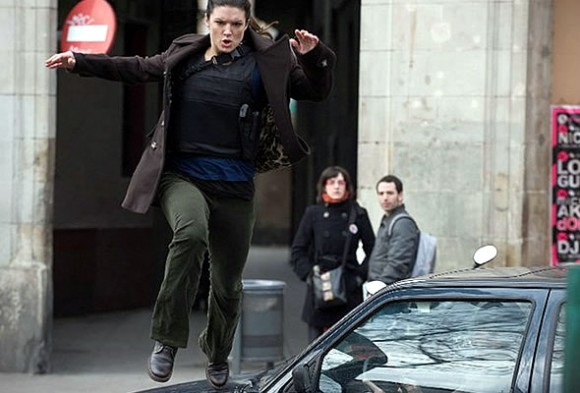
Haywire is also an interesting take on the international spy/action thriller, something like the James Bond or Bourne franchise.  It is spread out over a couple of European settings and several in the US, and there are many action scenes of daring do by the MMA champ Carano.   All this should add up to an excellent film.

Yet, it doesn’t.  With all of these great elements, Haywire doesn’t engage its audience.  It’s hard to sympathize with any of the characters because we don’t spend enough time with any of them to get to know or care about them. The empty center of this film is the risk that Soderbergh runs when he casts a non-pro actor as the lead—Carano does excellent stunts, but I never felt for her situation much.  The plot of the film is pretty much at the limit of what a director can expect an audience to hang on to, too.  I still don’t know why Mallory tells her backstory to the guy she kidnaps from the diner.  And if an action movie is to hold us, it needs some kind of stakes, like the life or death of the United States of America.  Haywire simply gives a mystery we don’t care much about.

Perhaps Soderbergh is just trying on the conventions of the action thriller, but in this movie, they don’t fit well.  Haywire is one beautiful sequence after another that doesn’t much go anywhere the audience is interested in going.

Thursday, August 2, 2012

August 2: And Everything Is Going Fine (2010 -- Steven Soderbergh)


★★★★★
Fourteen years after he last worked with Spalding Gray and six years after the performer’s suicide, Soderbergh created this wonderful documentary.  This is a multi-level film, and I’m glad Criterion has made it available to us.

Formally, the film is like a Gray monologue.  Soderbergh applies his considerable editing skills here (with Susan Littenberg) to link various film fragments into what reads like a 90-minute Gray performance.  The topics here are related just as they are in the other Criterion Soderbergh/Gray project, Gray’s Anatomy, with one topic leading naturally into the other.  It's an interesting formal experiment that works.

And Everything is Going Fine also follows a chronological order, starting with Gray discussing his childhood and moving on ultimately to scenes of him after his accident in Ireland.  But the key to the film--and what makes is so impressive--is the way Soderbergh sequences Gray's comments on art and on suffering/death.  As we move chronologically though his life, we hear Gray’s description of his mother and her suicide, we hear of his therapy and we hear about his art.  Gray repeatedly comes back to the point that his art is an effort to create order and his own identity out of chaos, even saying he starts acting and then telling stories because his life is otherwise chaos.  We hear him call himself a chaos man who comes into being only through the art of storytelling.  Ultimately, a completely random accident in Ireland leaves Gray crippled, and the film suggests this last lash by Chaos was as much as Gray could bear; Gray's suicide shortly afterwards was the triumph of Chaos, the loss of art, order and self.  The beauty of And Everything is Going Fine is that the filmmaker, and those of us who see the film, can have some insight into the psychic tension that Gray grew up with, lived with, and created art to cope with. 

And Everything is Going Fine works on many levels, and Soderbergh brings both his cinematic skill and his intellect to bear on Gray.  This little film, unique among the Soderbergh work I’ve seen, is one of my favorites by this director. 

Wednesday, August 1, 2012

August 1: Traffic (2000 -- Steven Soderbergh)

★★★★

Traffic came out the same year as Erin Brockovich, but its style is the anti-Erin alternative.  Erin Brockovich uses enhanced mimetic visuals and a transparent Hollywood cinematic style, but Traffic calls attention to its filmic elements in every frame.  It’s as though Soderbergh set out to make both a Bazinian and a Brechtian film in the same year.

From its opening, Traffic insistently calls attention to its cinematic elements.  An impossible yellow tint fills the wobbly, handheld frame as Javier and Manolo intercept a drug shipment in the desert of Tijuana, and the film goes on to alternate between three tints: yellow in Mexico; blue in the chilly corridors of East Coast authority and the homes of the authorities; and a rich, natural color in California.  This tinting suggests the lighting that Soderbergh had recently used in Grey’s Anatomy, but the highlights in the frame here are often burned out while the camera varies between steady and unsteady.  Also, occasional bravura blocking and editing segues from one plot line to the other, as when the camera turns from following Helena’s car to pick up Javier as he walks into bar on the same street.  Soderbergh uses no such attention-getting flourishes in Erin Brockovich.

There’s a clear purpose behind some of these meta-cinematic elements.  While Erin Brockovich tells the story of one woman’s struggle and follows this single character mimetically through its length, the subject in Traffic is much more general: drug use and its effects.  Traffic is a film of ideas, an analysis of drugs in the US, than it is the story of an individual, so the distancing that Soderbergh’s technique creates is appropriate here in a way it wouldn’t have been in the Brockovich story.  In addition to the distancing, the overt techniques help the film communicate better.  Traffic looks at drugs in three realms – Mexican distribution, the US government’s war on drugs, and American smugglers who distribute it – and Soderbergh color-codes each of these areas to help the audience keep the stories separate and reasonably clear.  And the hand-held camera gives a feeling of immediacy. 

Soderbergh also does an impressive job of handling a sprawling cast of characters to give breadth to his analysis of his subject.  Like Altman or PT Anderson or even Jean Renoir, Soderbergh finds depth, complexity, tragedy and smiles as his many characters deal with their respective roles in the drug trade.  Some characters are destroyed by their contact with drugs (Manolo, Salazar, Ray), some are damaged (Erika, Ana, Robert), and some flourish (Javier, Helena, Montel), but whatever their role or outcome, they’re all connected.  The achievement of this fine film is the range and detail of its description of its subject.

And all the while, many of the things I like most about Soderbergh are on display here.  He once again gets excellent performances out of his actors.  Michael Douglas plays the naïve politician/out-of-touch father well, and Erika Christensen all but outdoes him as the daughter who is slipping into a drug habit.  Catherine Zeta_Jones gives a complex performance that ranges from helplessness to confidence.  And Benicio del Toro dominates the screen as powerful giant who nonetheless seems vulnerable whenever he’s in front of us.  Seeing his performance here, it’s no surprise Soderbergh wanted to work with him again on Che.  And there’s a return role for Albert Finney here, too, albeit a minor one. 

Soderbergh’s fluidity and economy are also on display in Traffic.  From his rhythmic editing to the smoothness (or roughness) of his camera movement, Soderbergh continually engages viewers in the film.  For the most part, Soderbergh’s economical editing keep the film moving quickly.  In one POV shot, Erika sees an exit sign at a park, and a couple of shots later, we see her running down a small road.  At another point, Javier and Manolo are tasked with bringing in Francisco.  We soon see Javier walking into a gay bar where we find Francisco drinking, and after that, we find Javier and Manolo delivering a bound Francisco to Salazar.  Even Salazar asks how they accomplished the task that quickly, perhaps a wink at what the audience is thinking.  But Soderbergh can use such editing economy well to give us the facts we need without dwelling on  too much detail that slows the film down.

That said, there are a few plot points that suffer from too-economic editing.  I’m still unclear on how Manolo is betrayed, and I still don’t understand how he came to be handcuffed in the car with Javier.  I need a little more information there.  And unrelated to economy, I find the story a little more upbeat that I expected.  The bad guys are punished here, and there’s a faint glow of redemption on the horizon for the Wakefields.  Tijuana gets its ball field, Helena has a much better idea of how to live, and Montel continues his fight against the drug trade.  While not exactly a happy ending, the conclusion of Traffic is much happier than I might have expected.

But those small quibbles aside, I thoroughly enjoyed this film.  And on the Criterion blu-ray release, there are some excellent extras on the technical side of how it was made.
Monday, July 30, 2012

July 30: Erin Brockovich (2000 -- Steven Soderbergh)

★★★★
This film has aged very well, and watching it, I once again felt like I was in the hands of a director who was in absolute control of everything I saw on the screen.  Julia Roberts’ clothes, make-up and hair tell as much about her character as her acting and dialog do, and every detail of the mise-en-scène makes a major contribution to the sense of the place and the stakes in the film.  Soderbergh’s locations and sets always seem more important to his films than the settings of most filmmakers because his always seem to carry a lot of the important information.  In Erin Brockovich, the dingy little Jensen house tells as much about the family life there as the script does.  Details like its above-ground kids pool indicate a lower middle class family striving to provide for the kids but also show the way PG&E’s behavior is subtly undermining the efforts of the family.  Nearly every detail on a Steven Soderbergh screen carries this level of signification.  A Soderbergh mise-en-scène isn’t only appropriate; it develops the meaning in the film.

Having recently seen Magic Mike, I couldn’t help but notice the light in Erin Brockovich, too.  Whether in the run-down areas of LA or the empty desert around Hinkley, there’s often a muted yellow cast that’s warm and highlights the settings.  And at places from  Pamela Duncan’s home and Masry’s office to a local bar or the hot, cinderblock assembly room, the light is never harsh.  We can see every element of furnishing, every facial expression and every wrinkle in fabric.  The lighting works hand-in-hand with the sets.

And I like Soderbergh’s narrative economy.  There are parts a bit long and a bit too on-the nose in Erin Brockovich – when Matt communicates his acceptance of his mother’s helping the people of Hinkley by offering to get her breakfast, the scene goes on a bit too long, for example – but Soderbergh generally keeps his action moving forward quickly.  I especially like the way he uses sound bridges between scene cuts because they move me into the next scene’s action before I even see what’s happening.

Many people have noted that Soderbergh gets great performances out of his actors, and that talent is on ample display here.  Julia Roberts is far better than I remembered her in this role, playing a range of emotions (and winning an Oscar); the minor characters do equally outstanding jobs with their pain, grief and anger.  And the camera lingering on the faces of these characters in the soft light tells us even more of their backgrounds and struggles as they seem completely unaware of the cameras and mikes that were undoubtedly around them.  Soderbergh gets strong, naturalistic performances out of all these actors, both professional and non-professional actors.

And though the film isn’t even-handed about the PG&E controversy, it isn’t shrill either because the evil of the utility isn't the only focus of the film. Brockovich’s humanity informs all aspects of her life, and her dealing with the corrupt utility is just one of the arenas the film follows her into.  And we certainly see the flaws of the Brockovich’s side, too: Masry lacks backbone and wants to limit his exposure to the case, and Erin becomes obsessed with the case and ignores her family and relationships.  This isn’t a strident, anti-business propaganda piece.

Lastly, I’ve been thinking recently of a film class I took back in the 70s and of reading Andre Bazin.  I thought of Bazin’s cinema preferences a lot in respect to this and other Soderbergh works, and I think M. Cahiers would have loved this film.  Erin Brockovich is all about mise-en-scène and what you see on the screen.  The editing, though fluid and efficient, never calls attention to itself, nor does the dialog or acting.  Throughout his career, Soderbergh moves easily from one film language to another, and Erin Brockovich shows how thoroughly he can control this one.


Sunday, July 29, 2012

July 29: Gray's Anatomy (1996 -- Steven Soderbergh)


★★★
The strength of this film is Spaulding Gray and his storytelling.  Gray is witty, intelligent, wry and engaging.  He’s doesn’t act terribly over-the-top the way today’s cable communicators do, but he has enough variety in his voice to keep what is basically an 80-minute monologue from getting boring.  The tale of his retina pucker here is fun because it not only leads him to outrageous corners in search of a cure – Philippine faith healer, macrobiotic doctor – but it gives a chance for his intelligence to shine, as when he mentions Oedipus,  psychology and his mother.  There’s hardly a place in the monologue where interest can flag.

Soderbergh’s contribution to the film isn’t what I might have expected.  There’s not a lot a originality in his transforming Gray’s performance into film; instead, Soderbergh avails himself of mostly cinematic elements analogous to those available to theatrical director.  We get colored gel lights, silhouettes, moving backdrops and chairs, spotlights, and backlighting.  In the sweat lodge, there’s some dry ice smoke, too.  More cinematically, Soderbergh occasionally uses focus to direct our attention and some interesting cuts.  The one element he adds to the monologue is the use of documentary interviews shot in infrared of people who’d had had accidents affecting their eyes.  Some of those stories are so affecting that he clearly doesn’t need visuals to amplify them.  There’s also some engagement of the interviewees and Gray’s story because they people reflect on some of the points in Gray’s monologue.

Overall, this is a fun, engaging film thanks to Gray’s work.  There’s not a great deal of Soderbergh cinematic insight in it.

Saturday, July 28, 2012

July 28: Beasts of the Southern Wild (2012 -- Benh Zeitlin)

★★★★
I was pleasantly surprised by this Sundance fav, especially after my experience with BallastBeasts of the Southern Wild is not only creative and rich in the local color we’re used to finding in indies, but it’s also engaging.  It drags in a few places like the hurricane detention center, but for the most part, we’re interested throughout in who Hushpuppy is and what is going to happen to her. 

That said, the story isn’t the focus here.  Beasts is mythopoesis, a world come to life from the imagination of its heroine and rendered in affective imagery from a life of poverty.  From its first person narration through the things we see, this film shows us the world as its six-year-old lead understands and imagines it.  Her mind puts together vicious boars with legends of prehistoric beasts to create world-destroying  aurochs, and then she embellishes the tale with fear that global warming will break the beasts from their frozen stasis and unleash them on the world again. She sees a boat made out of a pick-up truck bed and a shelter with spikes coming out the roof to protect the survivors of the inundation.  A party is a blaze of color and fireworks, and when Hushpuppy decides she has to see her mother, she swims out to sea since that’s where her father said that her mother had gone.  There’s all the magical realism of Garcia Marquez here, interpreted effectively into film.

And as in Marquez, the reality that underlies the magic is not happy.  Hushpuppy lives in intimacy with the physicality of a hard  life -- its dirt, its gore, its heartbeat.  Her father is dying, her community is being destroyed, and she’s in desperate need of her mother.  Although far too young to deal with such terrible conditions, Hushpuppy persists until she finds her mother, confirmed by the legend-fulfilling act of frying alligator, and comes to the painful realization that the woman can never fulfill the maternal role Hushpuppy has wanted for her.  With this wisdom, Hushpuppy returns to her village, faces down the vicious aurochs, gives succor to her dying father, and leads the villagers on to what is probably another promised land.  Beasts is the mythopoeic creation of a new myth, perhaps one that’s real or perhaps one that’s imagined.  That doesn’t matter to a six-year-old.

Beasts of the Southern Wild has flaws of pacing, acting and script, but it is powerful portrayal of a young girl’s imaginative mind making sense of her world and overcoming the obstacles she encounters.  That portrayal alone makes this one of the more interesting films of the year.

Wednesday, July 18, 2012

July 18: Ballast (2008 -- Lance Hammer)

★★
A lot of the praise for this film is completely deserved.  It really is beautiful, from the brown symmetry of rows of cotton plant stubs to the purple and grey color palate of the cheap artificial lighting.  Even dark interiors managed to provide a line of highlight so we can make out the characters’ faces.  And there’s a very strong sense of local color, too.  Good American indy film is unexcelled when it comes to burrowing into a community the filmmaker knows well and showing us the truth of that community, and here we see the struggle of life in the Mississippi Delta, the loneliness and the few resources its people have.  We’re taken to the crack house, the convenience store and the impoverished interiors people live in.  Ballast is a deep look into a community we don’t often see.  This film has a community truth that the larger indy, Winter’s Bone, tried to have, but while latter managed only to seem contrived, Ballast feels authentic.

However, the pervasive monotony of this film makes it a long, boring experience.  For all the insight the film offers, Lance Hammer’s direction offers us too little cinema to engage us.  Over the 96 minutes of the film, the vast majority of the scenes are short, 30-45 second snips.  Such short takes can be good for variety in a film, but a feature film of them feels like a very long ping pong point.  Perhaps as a function of this directorial choice, the dialog in each scene is limited, too — 2-4 lines most of the time.  The repeatedly short takes and dialog snippets don’t sink the film right away because the cinematography and atmosphere are so interesting, but I was checking to see how much more of the movie I had left by the time I got to fifty minutes.  Perhaps these directing choices were compelled by the use of nonprofessional actors who weren’t really up to the challenge.  In particular, Micheal Smith, Sr. as Lawrence couldn’t engage the camera, so perhaps Hammer chose to keep the scenes short to minimize the dramatic burden.

For all its good points, Ballast isn’t a film I’ll want to sit through again.  Its strong points included, the main insight I take away from this movie is the importance of the range of elements that moves good cinema.