Monday, April 3, 2017

April 2: The Promise (2016 – Terry George)

★★★

On the surface a historical film about a love triangle set in Ottoman Turkey, The Promise is actually a polemic about the Armenian genocide carried out by the Turks at the turn of the century.  One of the film’s strengths is the way Terry George evokes the era, showing how the Armenians are integrated into Ottoman life.  We see Armenians going to parties, attending schools and doing business shoulder-to-shoulder with Turks.  We observe this life from the point-of-view of the Armenians, mostly from Mikael’s perspective, so we also get to go a little deeper in Armenian life, visiting a church and spending time in a villa owned by an Armenian businessman.  In the beginning of the film, the Ottoman world we experience is vital and cosmopolitan on both Christian and Muslim sides.

As we begin to notice the growing anti-Armenian sentiment, the film makes an important shift.  Soon we no longer see what’s happening in society in general but become locked exclusively into what’s happening to the Armenians.  We experience a series of gripping Armenian persecutions and losses, from discriminatory conscription at Mikael’s medical school to the destruction of his uncle’s business in Istanbul.  Armenians begin to vanish into prisons and become the victims of street violence.  We follow Mikael though brutal experiences and many personal losses, only leaving him so we can join an American reporter Chris Myers as he observes the wholesale evictions of Armenian villages as well as massacres of the people.  The narrow perspective points to George’s limited directorial purpose in the film, to recreate the injustice of the Armenian genocide.

With Promise having such a tight polemical purpose, it’s no surprise that that its love story receives cursory treatment.  Despite convincing acting by Oscar Isaac as Mikael, we feel little real emotion or engagement in the romantic triangle.  Charlotte Le Bon’s Ana often looks like a fashion model and doesn’t sell us on her attraction to either Mikael or Chris.  And for his part, Christian Bale’s Chris doesn’t seem to have feelings for anything.  He shows so little warmth or attraction to Ana that it’s hard to accept they would love each other, and Bale plays Chris as so emotionless that he doesn’t even project feelings about the horrors he’s documenting.  The most that Bale gives us in Chris is a cold, self-righteous anger at the genocide.  And Chris’ posture echoes the larger purpose of Promise, to focus on the horror of the killings rather than on the stresses of the love triangle.

As a gesture of being inclusive, Promise gives us a couple of Turks who resist the growing carnage.  A governor, for example, takes a major risk in warning an orphanage that its Armenian children will be slaughtered. He even allows Chris to leave the area despite an arrest warrant out for the American.  And Marwan Kenzari as Emri conveys an extraordinary vulnerability and decency toward his American and Armenian friends.  It’s unfortunate that George isn’t interested in this side of his story because theirs would certainly have among the most interesting in the film.

While the thrust here is to dramatize the Armenian genocide, it’s hard to watch Promise and not think of our contemporary political situation.  How could a cosmopolitan, tolerant culture suddenly turn on a segment of its population, as happened with the Jews in Germany or the Armenians in Turkey?  Promise doesn’t address the factors that led to the horror in Turkey, but it’s a reminder of how fragile a multicultural environment can be.  It's not much of a love story at all.


Atlanta Film Festival: Sunday April 2, 7 pm at the Plaza Theater.

Saturday, April 1, 2017

April 1: Waiting for B. (2015 – Paulo Cesar Toledo & Abigail Spindel)

★★★★

As it starts, Waiting for B. shows us a group of enthusiastic Beyoncé fans in Brazil starting to line up at the stadium two months before her concert.  Young, animated and mostly gay, they want to be first in line when the stadium opens.  In fan mode, they dress like Beyoncé and dance in sidewalk imitation of her choreography; one group of friends even does Beyoncé imitation performances at a Sao Paolo gay bar.   They joke, tease, and vamp Beyoncé.  

But even as we enjoy the irreverence and enthusiasm of the group, we begin to see that the posing, glitz and energy is a contrast to the daily living conditions of these kids.  Paulo Cesar Toledo & Abigail Spindel take us into the intimacy of the waiting kids’ tents, where we eavesdrop on conversations about issues that concern them like race and discrimination, discussions that Beyoncé’s public image naturally invites but that has particular resonance in Brazil's poor, mixed-raced population.  We also hear about the kids' insecurities and vulnerabilities like dating and relations with their families.  And the film takes us along with some of them beyond their waiting to see their modest homes, their terse interactions with their families and their daily grind of public transportation and work.  They are part of the poor youth of Sao Paulo, and we see that Beyoncé fandom gives them not only a way to express a sexuality they generally suppress but also a way to think of a world outside the one they live in most of the time.

Other scenes show us an even darker aspect of their lives.  An occasional car goes by that shouts an anti-gay epithet, but the waiting fans quickly close ranks and respond in kind, secure in their group.  During a soccer match at the stadium a couple of weeks before the concert, however, they’re massively outnumbered, and Toledo and Spindel capture their wide, alert eyes as they hunker down out of sight of the soccer attendees.  Even on the level of imagery, we sense the menace the Beyoncé fans feel in the middle of the mass of macho soccer fans.  In contrast to the youth, delicacy, play and agility we see waiting for the concert, the soccer fans are older, stockier, louder, and aggressive, particularly since many were drinking.  The sequence with the soccer fans powerfully implies the danger the kids live in only because of their sexuality.

Waiting for B. starts as film about Beyoncé fans but gradually morphs into a description of the social environment that poor, out, gay youth faces in Brazil.  It leaves us simultaneously celebrating the energy and confidence of the kids but also concerned about their vulnerability in a society that largely doesn’t want them.  Few documentaries evoke such a range of emotions simultaneously.


Atlanta Film Festival: Friday March 31, 9:30 pm at the Plaza Theater.

Thursday, March 30, 2017

March 30: The Lost City of Z (2016 – James Gray)

★★★

Lost City of Z doesn’t satisfy an audience as much as it could.  It’s a historical movie with rich visuals of the UK as well as South America, and it’s an interesting story of adventure and exploration at the turn of the century.  It also deals with universal concerns like love, family, class and equality that impact all of us.  But despite all these appeals, Z doesn’t engage or reward us.

The script is a major problem here, and its biggest flaw is its failure to give us a consistent central figure.  Throughout, it’s hard to understand what drives Percy Fawcett.  Early on, it seems his battle is with an Edwardian society that won’t accept people of his class, though his problem might also be one of family honor since we’re told people knew of his father’s alcohol problem.  But we also see Fawcett and his wife talking about needing money early in the film, too, so that’s also posited as a possible motivation.  After Fawcett’s first trip to Bolivia, the script introduces religion and its role in perpetuating bigotry, and that topic even arises at the end of the film.  But it also seems that Fawcett has become concerned with his reputation as the film progresses.  Z moves from one of these motives to the next, dropping the preceding motivation in favor of the immediate but not delivering on any particular topic.

The script also has structural failings.  For example, a large section in the middle of the film follows Fawcett in WW I, but it’s not clear what this part contributes to the search for Z or to the development of the Fawcett character.  It’s an overly long digression with only vague relevance to the rest of the film.  Similarly, Fawcett’s visit to the opera house on his first trip to Bolivia is a highlight that the film emphasizes.  It’s not only visually striking, but it delivers the pointed theme that Fawcett’s survey work will help preserve the status quo in the area, which includes the brutal enslavement of the locals.  By the time of Fawcett’s last trip, the opera house is in ruins, but we’re left to wonder what to make of the script’s insistence on the contrasting scenes and how to relate them to any continuing theme in the film.  Another problem is that the dialog in Z can overstate conditions the film hasn’t shown us and try to create a dazzle that the script hasn’t earned.  There are many examples of this, but one of the most striking is at the end when Fawcett tells his son that they have seen things no one else has seen but the film hasn’t shown us these things.

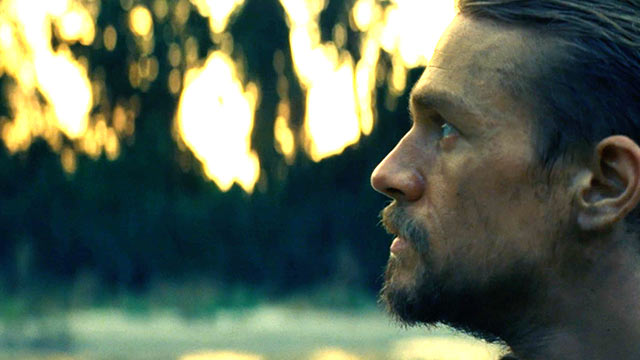
Script aside, the performance of Charlie Hunnam as Fawcett, is another problem in Z.  Though the film gives him room for communicating Fawcett’s passion, Hunnam remains so aloof that his verbal assertions don’t mesh with what we see of him on screen.  We hear Fawcett talk about his intense desire to prove the existence of the City of Z, but we hardly see him obsessing or preoccupied by that passion.  In a similar vein, we hear him talk about his love and attachment to the children, but we feel little chemistry between them based on what we see on screen.  Our failure to see a connection between Fawcett and his family becomes especially important at the end of the film when his rebellious older son becomes one of the main characters.

Despite all these weaknesses that hobble Z throughout, James Gray manages an eerily beautiful ending to the film, one illuminated in the jungle by torchlight as Fawcett moves towards peace.  It’s a pity that haunting ending couldn’t come as the final images of a film that held together well before it.


Atlanta Film Festival: Thursday March 30 7:00pm at the Plaza Theater.

Thursday, March 23, 2017

March 23: Woman on Fire (2016 – Julie Sokolow)

★★★

Julie Sokolow’s documentary gives us a portrait of Brooke Guinan, who became the only transgendered firefighter in New York’s Fire Department.  Brooke started life as George William and always wanted to be the third generation of firefighters in her family.  Woman on Fire gives us interviews with Guinan’s family, NYFD personnel, and Guinan herself to reconstruct her story, intercutting those with occasional shots of locations, photos or other memorabilia.  It’s a stolid approach to documentary.

Along the same lines, the content of Woman on Fire should be more interesting than it is, especially given its subject.  Sokolow’s interviews remain deferential, and we don’t hear much that we wouldn’t have expected.  Guinan’s mother was surprised at her son’s transition and had to adjust to it, Guinan faced discrimination at the firehouse, and Guinan has managed to find acceptance finally.  While the facts are interesting, Woman on Fire doesn’t give us insight into the driving energy of Guinan’s life.  We get little of how she felt as George or of what challenges she feels now.  Sokolow keeps a respectful distance from her subject with the result that the film feels more like a newspaper article than a documentary film.

There are interesting facts here.  For example, Guinan’s abiding interest in comics and superheroes is clearly linked to her desire to be a firefighter and to her trying to understand her own unique sexuality.  Guinan herself brings this up, but the film doesn’t pursue the topic further despite the correspondences Guinan sees.  It’s also interesting to learn that Guinan’s partner is a straight male, but the film doesn’t look deeply enough into this relationship to help us understand it.  What are the kinds of emotions and feelings that arise in both parts of such a relationship?  Woman on Fire could have brought some genuine insight into their lives if Sokolow had asked even a few more questions about that.  And one of the most interesting facts we learn doesn’t even focus on Guinan.  Her father had been one of the first responders in the 9/11 attacks, and he changed as a result of the experience, becoming withdrawn and eventually divorcing his wife.  This isn’t the film for that story, but there’s clearly another documentary waiting to look at the effects of that catastrophe on the people involved in it.

In general, Woman on Fire is a faintly hagiographic portrait of its subject that doesn’t take us deeply into Guinan’s experience as she sorted out her sexuality and forged her identity and future.  The film has a great topic, but it doesn’t help us understand what it felt like for Guinan or give us much insight into the myriad ramifications of transitioning from being a male to being a female in our male-oriented world.


Atlanta Film Festival: Sunday March 26 8:00pm at the Plaza Theater.


Wednesday, March 22, 2017

March 22: Cold Breath (2016 – Abbas Raziji)

★★★★

The surprises keep coming out of Iranian cinema, and Abbas Raziji’s Cold Breath numbers among the more recent.  Who would have expected a film about changing gender identity to emerge from one of the most hardline theocracies on the planet?  And yet Cold Breath is just that.

It’s also more.  Raziji builds his characters and their situations very deliberately, keeping us involved in the movie and keen to understand connections.  First, we meet the principals with little explanation of the way they’re related, and we then learn some details of each ones’ life as we moved among them.  Cold Breath parses out this information, always just enough to draw us on to the next detail until a network of relationships emerges naturally.  It’s an experience of cinematic pleasure when details like Qasem’s tender care for his father eventually fit so aptly into his character and into the developing story.  The way storylines merge and divide in unexpected but logical ways also satisfies.  The direction the film takes at end is as perfectly consistent with what we've seen as it is unanticipated..

Cold Breath doesn’t shy away from melodrama, but Raziji uses it with deftness that that recalls the skill of the better directors of the late silent era.  For example, Maryam lives in grinding poverty, and when she discovers that her daughter Raha has cancer, she tries to give the child up because she can’t provide for her treatment.  It’s hard to imagine a more melodramatic situation, but Raziji sells it with effective direction and a strong performance from Bita Badran as Maryam.  The relationship between Raha and her brother Reza could similarly ease into sentimentality, but Raziji captures a touching sincerity as the older brother tries to protect and care for his sister.  Individual scenes, too, build to a deeply emotional intensity.  For example, as Maryam is overcome with emotion at a hospital, Qasem can only talk to her and reach toward her.  He can’t touch her to comfort her in public because the two aren’t married.  Cold Breath burns with such intensity and humanity.

Much of the heightened emotion in the film comes from the social actuality of contemporary Iran.  Oppressive poverty afflicts characters like Maryam and her family, while gender limits what some characters can do.  Homa, for example, wants to leave Iran, but her father holds her passport and won’t let her go; even Maryam’s decision to live as a woman is in part a result of society’s not accepting an effeminate man.    The film also shows a sharp class divide between the poor and the professional class when the affluent family that employes Maryam enters the film.  But love and compassion mitigate some of these factors, from Dr. Mansour and Qasem helping out Maryam to the tenderness between the children.  Cold Breath gives us an Iran of caring people in a harsh world.

The film is not without its drawbacks.  Sometimes it doesn’t give us enough information for us to understand characters’ motivations, and at other times, we wonder why a character like Nasrim is even in the film.  Occasionally, Raziji can’t maintain the balance between good melodrama and bad and tips into the latter, like by intercutting a cock fight into a fist fight between two male characters.  Cold Breath's blue and gray, desaturated color scheme works wonderfully, but the cinematography becomes attention-grabbing at times.  It’s not clear why we focus on colored chicks at the beginning of the film or that it’s necessary for the camera to tilt to a right angle a couple of times as Maryam smokes and moans quietly.

But little lapses and excesses hardly detract from this melodrama with a transsexual at the center.  The beauty in Cold Breath is the way the film combines grittiness, love and unexpectedly thrilling storytelling.


Atlanta Film Festival: Monday March 27, 9:45pm  at the Plaza Theater.

Tuesday, March 21, 2017

March 21: Atlan (2015 – Morin Karimoddini)

★★★★


Atlanta Film Festival: Tuesday March 28, 9:15 pm at the Plaza Theater.

Monday, March 20, 2017