Wednesday, September 10, 2014

September 10: Rififi/ Du rififi chez les hommes (1955 -- Jules Dassin)

★★★★★

Rififi is a great heist procedural that sets the standard for suspense in showing a complicated theft.  It’s one of the first films in which we watch the gang collect their information and tools with such studied precision.  From a hotel window, Jo watches the neighborhood’s regular comings and goings, and we watch Jo through a downward tilted camera that puts him in the foreground and lets us see what’s outside the window in the background.  We get the whole scene.  The team methodically gets key castings, times car trips, cases the safe and tests the alarm system.  But the crown jewel is the heist itself, a 28-minute study in how silence can make good cinema.  Quiet beyond the moment they don’t need be, the quartet of robbers tip toe around the closed jewelry store, flinching at every sudden noise and hitting our nerves with theirs.  Jules Dassin amps the tension here beyond that of many more technically involved heist flics.

But Rififi doesn’t stop at effective suspense.  It creates an interesting character, the middle-aged Tony, and follows the challenges that he faces after he’s released from five years in jail.  Like Eddie Coyle in Peter Yates’ movie, le Stéphanois here is no longer at the top of his game.  In the first scene of Rififi, we meet him losing at a card game and unable to continue playing because he is out of money.  His old reputation doesn’t have the value of hard cash with the other players, and a persistent cough shows his health to be broken.  In addition, his girlfriend has long abandoned him, and younger criminals question whether he’s up to pulling off a job.  Dassin’s Tony, though, isn’t a man who is ready to end his career at this point.  Tony gives a severe, and unwarranted, beating to his former girlfriend, Mado, but he shortly has to reckon with his own injustice when he realizes that Mado’s still enough in love with him not to betray him.  Tony also a passion for his godson, Tonio, and his love for the boy has an important bearing on the outcome of the film.  As Rififi speeds toward its conclusion, we watch Tony draw on his past experience and connections to track down the people who have kidnapped the boy and to take his revenge on them.  In Tony, Dassin gives us an aging man who can still grow and can muster himself enough to be effective in the world, even if he can’t ultimately sustain the effort.
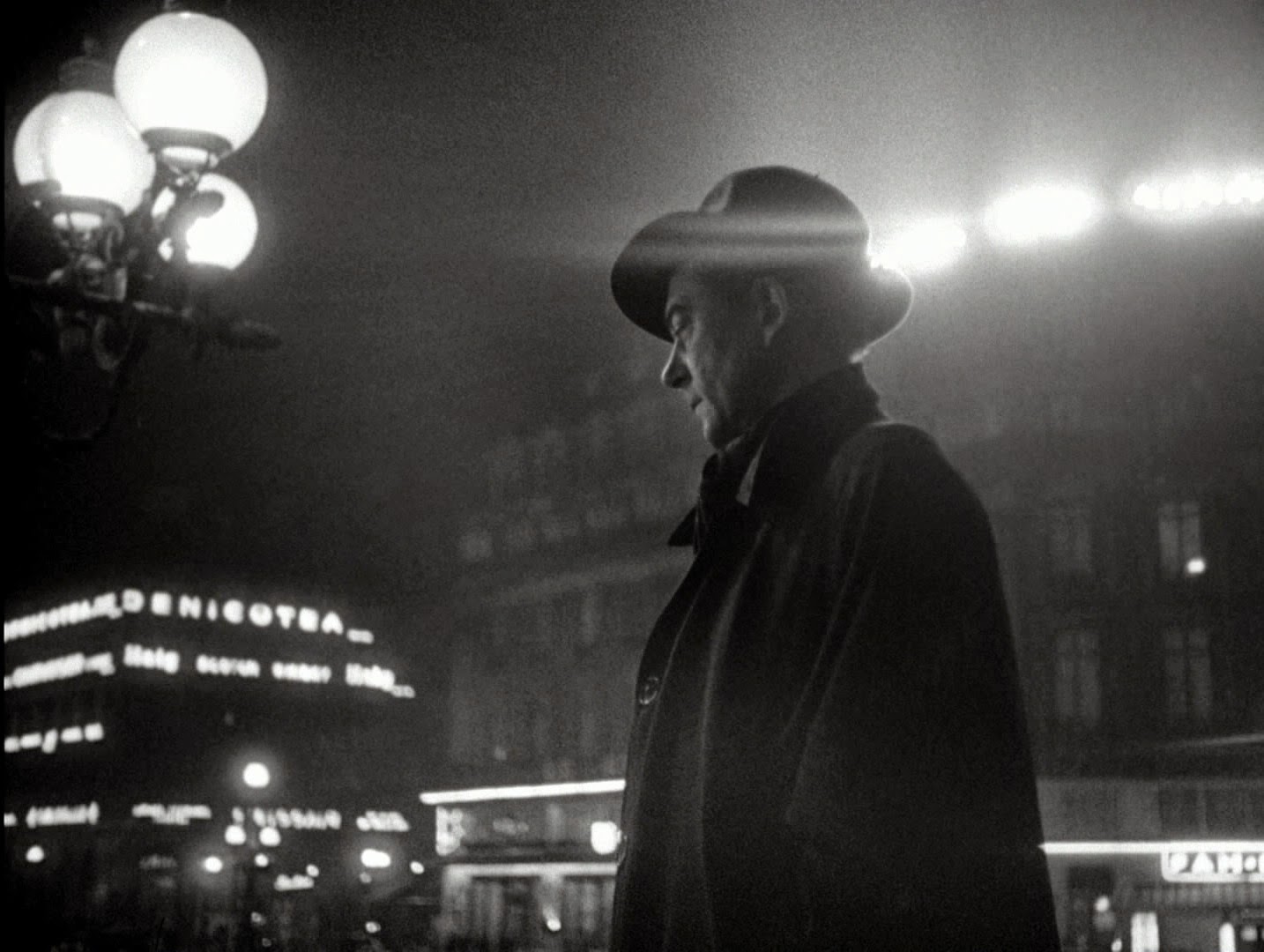
Another of the other attractions of Rififi is its affection for Paris.  Dassin’s camera loves the city and moves throughout it day and night.  We see the location of the heist in the Place Vendôme and watch the beginning of the robbery in a car theft at the nocturnal Place de l’Opéra. The Paris Metro figures in the film as Tony rides across the Pont de Bercy and when he follows a drug delivery that starts at the Art Nouveau Port-Royal station.  Tonio is kidnapped in the Jardin du Luxembourg, and Tony consults contacts in Montmartre to help find the boy.  And then there’s the shootout climax in the suburbs.  Rififi loves the city of Paris at all hours of the day and in all weather conditions, and Paris is an important part of the beauty of Dassin’s images.

Another important part of this beauty is Dassin’s cinematic technique.  He uses low key lighting often to create gritty visuals that are a standard element of film noir vocabulary.   Even early in the film, at the card game and, shortly later, at the café, we see rough men with their faces sharply cut by shadow.  And accompanying this lighting is a persistent use of deep focus.  During the robbery, for example, low key light adds drama while the expansive depth of field lets us watch and respond to the faces of several of the robbers at the same time.  Dassin uses deep focus for other purposes, too.   For example, when Mario and his wife Ida are killed, the deep focus maintains a same-shot, visual dialog between them as they face Grutter and Remi.  In other scenes, Dassin uses depth of field to portray action without cutting.  After a rapid series of cuts as Tony drives his godson home, Tony stops the car at the house, and the camera backs up and, too, stops.  The shot continues without a cut, though,  while from the back of the extreme depth of field, we watch the Tonio’s mother run to the car.  The deep focus lets Dassin give us all this information in one shot so he can rhythmically reinforce the action.

One of the most effective of Dassin’s techniques is the way Rififi slowly moves from the stark, steady realism of the card game and the robbery to increasingly macabre visuals.   Once the robbery has been completed and Grutter has started to try to grab the jewels, we encounter an odd tracking shot that shows Grutter leading César though an unlikely forest of floorshow props.  The props separate as the two go through and close around the tracking camera, a claustrophobic shot style we have yet to encounter in the film.  And we get a similar image when Tony later finds César there.  The claustrophobia and odd props add to the sense that the characters are leaving the bounds of the normal and moving into another sphere.  In another unusual image shortly after, Dassin places Tonio’s large, inflatable clown squarely in the center of the screen as the London fence brings his cash for the jewels.  In fact, the fence even comments on the big, ghoulish toy and playfully punches it, giving the whole scene an unusual, menacing, surreal air.

Rififi continues into increasingly macabre imagery.  When Tony shoots the drug-addled Remi, water is running into a small sink above the body, and Dassin’s camera lingers on the sink as it fills and then overflows onto the floor, a visual representation of how what's typical and to be expected have been usurped.  Shortly after, we experience the strangest imagery in the film.  As the wounded Tony tries to drive his godson home in a convertible, we see upward images of the child standing in the car seat dressed as a cowboy and waving his gun around.  Cold, he puts on his godfather’s over-sized coat, and we watch shots of the car moving quickly along the road with bare tree branches reflected on the windshield intercut with shots of the road and shots of the sky.  It’s a disturbing sequence of short, discordant images that captures Tony’s desperation as he tries to get the boy home.

Rififi is a dark, skillful blend of many compelling elements of film noir that goes beyond the genre to create a memorable film.  Blacklisted in the US and working with a small budget, Jules Dassin creates an important crime film with more creativity than resources here.  It's an effective cinema experience.


Wednesday, August 20, 2014

August 20: Mood Indigo/L'Écume des jours (2014 -- Michel Gondry)

★★★★

Mood Indigo is a visual treat that aims no further than its visual inventiveness.  It has the completely predictable narrative of an opera – boy meets girl, they marry, she dies – but if the focus of opera is music, the creativity here is visuals.  It’s a thrill to watch how Gondry embellishes this thin story line with outrageous creativity.

A lot of the visual strength here comes from Gondry’s ability to violate categories and scale.  In Colin’s kitchen, Nicholas cooks from a video cookbook, but when the right ingredientss aren't available, the video chef’s hand emerges from the screen and hands them to Nicholas.  Video in Mood Indigo doesn't remain a series of stimulated pixels but becomes physical reality.  And there are other wild kitchen fantasies, too, including meals that assemble and dissemble themselves as well as eels coming out of faucets.  Gondry’s visuals can have a logic of shape and form rather than reliance on typical cognitive categories.  The same categorical violation lets Gondry invent Colin’s pianocktail. which translates music to mixed drinks, and it's behind the weapons manufacturing that requires nude men to incubate the guns.

Another part of Gondry’s inventiveness comes from his ability to play with space and scale.  The man in the mouse costume is the size of a mouse we'd see in everyday reality, a cloud-car can tour Paris, and there’s a car race to the altar for the wedding of Colin and Chloé with little automobiles racing through church stairwells and up walls to get to the altar.  And in all this fantasy, Gondry is still happy to throw in some very recognizable barbs at the venality of the church.

There is also a lot of recognizable play with materials here.  Feathers float as snow but act as feathers when they land, and amid all the hard surfaces of Mood Indigo’s world, Gondry chooses soft yarns when the camera goes into Chloé’s body and we see her vulnerable organs.  After their wedding, the newly-weds leave the church dressed but floating in water with bubbles around them.  Throughout the film, a textural richness amplifies the creativity of its images.

There is also multi-leveled self-referentiality at work in Mood Indigo.  The film opens with a view of rows of people on typewriters, the typewriters moving along each row from one typist to the next.  This scene suggests Brazil and evokes the complexity of Terry Gilliam, whose inventiveness would be quite at home in this film.  There’s no manifest causal link between the story of Colin and Chloé, though viewers are clearly invited to try to make one, and the possibility of such a connection is completely void when we see Colin himself trying to type, apparently wanting to save Chloé by writing.  The mise en abyme here is a purely aesthetic pleasure.

Viewers wanting character arcs and plot twists are certain to be disappointed in Mood Indigo because Gondry has little interest in these elements of cinematic storytelling.  Instead, this film is an intense imaginative engagement with a series of poses, poses which follow the most basic of narratives.  For viewers inclined to marvel at ingenious visual creativity, Mood Indigo will be a treat.  And at moments, it can even touch the fragile heart in us all.  


Saturday, August 9, 2014

August 9: Sorcerer (1977 -- William Friedkin)

★★★

If this had turned out to be the film that Friedkin intended, it would have been fantastic.  Unfortunately, Sorcerer has many problems, and the coup de grâce is that it never approaches the quality of Clouzot’s cover of the same material, The Wages of Fear.

In Clouzot’s tight film, the opening section sets up a world whose values inform the subsequent road adventures.  These values – pessimism, opportunism, amorality -- heighten the suspense as well as give us an investment in the characters.  Friedkin might have been trying to do the same in the opening section of Sorcerer, but the film rambles into a two-stage opening that neither creates a sustained mood nor establishes characters that we care much about.  In the first stage, we meet the characters on their individual home turfs as assassins, robbers, terrorists and con artists; after this extended section on four continents, we then see these characters for a while in a small, Latin village.  This extended introductory section of the movie has so much sprawl that we have no time to connect with any of the quartet; worse still, the information in this section is only modestly important later in the film.  While we eventually have the Palestinian bomber, Kassim, blowing a fallen tree out of the road, the Frenchman Victor’s fraud is irrelevant to the rest of the film, we learn so little of Latin Nilo in the intro that he’s even hard to recognize when he arrives in the village, and the calm efficiency we see of the American Jackie in the introduction has little take up in the rest of the film.  It feels as if Friedkin is aiming to recreate the pervasive existentialism of Clouzot’s opening, but Sorcerer instead gives us a long, diffuse introduction to some bad guys who inhabit a world that isn’t necessarily corrupt.

When the trucks finally get rolling, so does Sorcerer.  While there are several fine action and thrill scenes in the film, the best by far is the scene of the trucks crossing the rope bridge in a storm.  As the trucks lurch and lean, it’s only the most jaded of viewers who won’t gasp and wonder how Friedkin created the effects.  But such action sequences aside, the other elements of the film are sour here.  We are most attached to Victor through the introductory section, but his role is diminished in the travel section; conversely, the man we see the least in the introduction, Nilo, becomes one of the most important characters on the trip.  As Nilo becomes the coward we recall in Clouzot’s Jo, we are far less disgusted here because we don’t know much about him and we don’t see the hypocritical contrast between the gangster poseur and scared weakling Nilo soon becomes.  And one of the strangest transformations is when a shot of the grimly determined Jackie cuts to a shot of Jackie having a hallucinatory nervous breakdown.  And that in a desert that has suddenly replaced the rain forest.  Such contrastive cuts can have an effective role, but in a film that doesn’t use this technique for the first two hours of narrative, it feels more like bad film-making than innovative styling.

Friedkin’s ambitions are evident here -- grand existentialist statement, explicit anti-Americanism, intertextuality with his earlier Exorcist success (witness the title, flashes to pre-Colombian masks, and the menacing grill of one of the trucks).  But Friedkin’s failure to focus and his lack of control prevents Sorcerer from delivering on any of them, and there’s not even enough excess to provide the kind of pleasure we might get from a similar effort by a director like Herzog.  Sorcerer delivers us some grand action scenes in the middle of muddle that neither achieves the profundity it aspires to nor satisfies our desire for a tight aesthetic experience.

Thursday, August 7, 2014

August 7: The Wages of Fear/Le salaire de la peur (1953 -- Georges Clouzot)

★★★★★

This movie just keeps thrilling.  Deservedly famed for its suspense, Wages of Fear doesn't draw on sudden surprises and camera cheats.  Instead, its bleak, existential world wrings out of us all hope of anything good happening to the characters, and we expect its world of material determinism to ultimately punish the quartet of risk-takers at the center of the film.  After the happy achievement of the men blowing up a boulder that had blocked the road, a rock that was dislodged by the explosion tumbles down the hill toward a jerry can filled with nitro.  Given the world of the film, we don’t really know whether or not the rock will hit the can and destroy the men and their trucks.  In this case, it doesn't, but later in the film, a happy achievement will be quickly followed by a devastating one.  Because the world of Wages of Fear is so bleak, we watch it in continuing expectation of something bad happening.

Many elements of Wages of Fear create this world, but the oft-criticized, but its long set-up is one of the most important.  Love, friendship, fairness, honesty, and decency have a place in this world as a group of expats jockey with each other for advantage.  In the opening of the film, we see kids playing with roaches whose legs are tied together, a bleak symbol of the world here (and one Peckinpah references at the opening of The Wild Bunch).  We soon see Mario mistreating Linda and pragmatically shifting his friendship from Luigi to Jo.  Meanwhile, Linda’s boss uses her sexually, and flaunts it to Mario, while she sees her situation as part of the deal.  The unscrupulous O’Brien won’t help his former friend Jo and recruits expats for the suicide job of transporting the nitro because they're so readily expendable.  The situation is so bleak that the despairing Italian kid hangs himself…at a shrine to the Virgin.  Introduced to a world like this, we don’t expect happy things to occur when the men finally take to the road, so we watch, expecting the worst at any moment.

The existential emptiness here becomes more obvious later.  Age, in the character of Jo, has neither wisdom nor respect.  Despite all his tough guy posturing early in the film, Jo is stricken sick with fear as they start transporting the nitro and is later beaten by the younger Mario, who explicitly says physical strength shouldn't be a determiner but is.  Injured and reminiscing about a high fence he’d never looked behind as a kid, Jo dies saying “there’s nothing there,” a somewhat on-the-nose summary of the film's philosophy.  And after we get to know the amiable Luigi and Bimba, Clouzot kills them in an explosion we don’t even see.  A flash of light interrupts the conversation of Jo and Mario, and we hear an explosion.  Clouzot then cuts to a column of smoke in the distance.  There’s no drama or heroic struggle when we lose that truck; instead, the two men just vanish without meaning or significance.

The bleakness, which creates so much of the suspense of the film, is not without its moments of beauty.  At one point, Clouzot’s camera captures a family of rainforest Indians watching the oil well burn, and there’s memorable beauty in the oil-filled crater left by the truck explosion; the rhythmical pumping of oil from the pipeline is like a heartbeat as gushes of black oil slowly fill the crater.  It’s the ruptured artery of the film’s dark world.  And there’s a strong, graphic shot of Mario looking at the lattice of beams holding up the turn-around platform on a curve of the road.  The beams cast an imprisoning shadow over Mario as he walks around outside the platform.  With the help of cinematographer Armand Thirard, Clouzot manages to find dark beauty in Wages of Fear.

This film is a bleak thriller that gets no small part of its life from its pessimistic worldview.  Hitchcock may thrill with bravura, panache and psychology, but as Wages of Fear shows, Clouzot can thrill with philosophy.

Sunday, August 3, 2014

August 3: Insomnia (1997 -- Erik Skjoldbjærg)

★★★★

Here is an unusual, engaging crime procedural that depends way more on atmosphere and psychology than on the case details that are slowly revealed to us.  Insomnia’s cinematography creates a world of flat, unexceptional interiors made of the mundane, baseboard heating and spare, functional furnishings.  The film’s high key lighting banishes shadows and contributes to the sense that the light in this town of the midnight sun fills every space.  And when when we're in Insomnia’s bright, flat interiors, every window shows us a burned out exterior where the light is so strong that no detail is visible.  The light in this film is a character, and it is an important factor in the increasing psychosis of the chief investigator, Jonas Engström.

From the time our we first meet Engström, we have the sense there is something wrong.  He’s on a plane with Erik Vik, his fellow investigator, when the pilot announces they've crossed the Arctic Circle.  The dozing Vik rouses a bit, and then we hear the exact same announcement again, as though Engström’s mind has momentarily slipped a notch, missed some information, or lapsed into a daydream.  It's not clear exactly what happens here, but we quickly realize that Engström’s mind is working in a way slightly different from ours.

We’re soon following the sleepless Engström as he tries to solve the murder of Tanja but accidentally shoots Vic.  The detective then begins to build a web of lies to frame Tanja's murderer, Jon Holt, for Vic’s death, but the lies becomes more and more complicated, and Engström finds himself both the object of a police investigation and victim of blackmail by Holt.  And as Engström increasingly struggles to create a coherent story to account for the facts, director Erik Skjoldbjærg also mixes in a couple of uncomfortable scenes charged with sexual energy between Engström and local women.  And all the while, Engström is unable to sleep because of the harsh, omnipresent light in Tromsø, and his psychology, fragile at the beginning of the film, shows more and more signs of strain.

Skjoldbjærg's achievement here is that the details of the crime are not the focus of interest in Insomnia. Instead, we have an edgy, fascinating, detective improvising an increasingly complex and increasingly high stakes network of lies while he is on the verge of cracking in this environment that would stress even a sane person.  And that is what we watch with fascination.

Monday, July 21, 2014

July 21: Jodorowsky’s Dune (2013 -- Frank Pavich)

★★★

Formally, Jodorowsky's Dune is a fairly conventional documentary.  It’s mostly a series of talking heads, though the animation from the detailed storyboards of the script certainly helps us get a modest feel for what the project might have looked like.  And though it’s hard to imagine another structure, the predictability of the film’s progress becomes somewhat boring.  We go from Alejandro Jodorowsky’s work before this project to a very long list of big-name people he got involved to a conclusion of the ripple effects of the project.  The form here isn’t what engages.

Instead, it’s the vision and audacity of Jodorowsky that keeps us in the film.  Jodorowsky was immersed in the cultural currents of the late 60s/early 70s.  From absurdist theater, we went on to make two wildly experimental films, and his Dune was to  be based on what he wanted to talk about – the expansion of consciousness – rather than the contents of Herbert’s work.  One of a couple of the self-referential aspects of this story shows how director Jodorowsky essentially became a prophet, like Paul of the novel, stimulating the disciples he recruited for the project to open their minds.  And we can note the ongoing effect of Jodorowsky's teaching in the subsequent careers of figures like HR Giger, Dan O’Bannon and Chris Foss.  Jodorowsky pulled these creative artists into film, and they all went on to make important contributions arising, in part, from the way Jodorowsky developed their talent.

There is a lot of Entertainment Tonight in the overlong middle section of the film as we hear funny stories about Jodorowsky’s encounter with Pink Floyd, Dalí, Jagger, David Carradine, and Welles.  But the range of Jodorowsky’s contacts, the countries he worked in, and the areas of 70s pop culture he mined are a fascinating look into that era and into some of the cultural trends at work.  Jodorowsky lived at the nexus of those trends at that time, and part of the pleasure of Jodorowsky's Dune is to participate in that moment.

This film also makes the worthwhile observation that Jodorowsky's version of Dune became seminal to an important part of future sci fi cinema.  Like Paul’s death in Dune leads to the fertilization of the entire planet of Dune, so did the failure of Jodorowsky’s Dune lead to a dispersion of talent that went on to fertilize many important sci fi projects.  We see the echoes of Jodorowsky’s Dune in Star Wars, Alien, Prometheus, and Blade Runner among many important sci fi movies.  And it’s not that Lucas or Scott stole ideas from Jodorowsky but that the talent that worked on those later projects developed its vision from Jodorowsky’s prophetic leadership. 

It’s in describing this relationship that the important value, and pleasure, of Jodorowsky’s Dune lies.


Tuesday, July 1, 2014

July 1: The Freshman (1925 -- Fred C. Newmeyer & Sam Taylor)

★★★★

In a time that filmmakers would use melodrama to engage its audience, Lloyd created one of his most affective films in The Freshman.  It’s impossible not to empathize with Harold Lamb here.  The freshman is an archetypal American figure: optimistic, determined, and naïve.  Set upon becoming the Big Man on Campus, the hard-working Harold soon finds himself being abused by a jaded clique of college students who fake their like for him in order to trick him into using his limited money to buy them ice cream and sponsor a party.  Because of his naiveté, Harold doesn’t realize the ruse as they laugh at his jokes, imitate him, and pursue him to dance with; in fact, the group is mocking him to his very face in all these situations.  As Harold obliviously allows himself to be used by these people, our sympathy for him builds, stoked even further by comic misadventures like his unraveling suit and his role as the tackle dummy at football practice.  Our involvement climaxes when the angry Cad reveals the ruse to Harold, who tries to keep on a brave face before he breaks down into tears.  It’s inconceivable that Harold Lloyd at one time wanted to delete the crying scene from the film since this is the moment of our most intense involvement with the character.

The big ending of The Freshman has its own hooks.  Credit much of the success of this concluding episode to Pat Harmon as the Football Coach.  Harmon’s Coach is a bull of a man, prone to very physical expressions of his emotions like throwing his hands in the air, running in circles and bending over as if to beat the earth itself.  As his bench gets slimmer, the bad-tempered, stubborn man adamantly refuses to let Harold play even as the clock is running out and the refs are telling him he’ll have to forfeit.  His players can’t convince him to run Harold in and, as he fusses and fumes on the sidelines, Harmon takes the tension in the film to a new peak.  The Coach is also responsible for one last cruel joke on Harold, sending the eager sub in only to change sweaters with one of the other players.

But Harold finally gets to play, and as the seconds tick away, he almost saves the game and then quickly loses it again, with intercuts to the Coach’s sideline reactions building pressure at each shift and getting us more invested in the action.  Of course, this is a comedy and Harold is ultimately able to pull off a victory for Tate thanks to the same determination and optimism he brought to the school at the beginning of the film.  And he gets the girl.  But we've been put though an emotion ringer in getting there.

It’s The Freshman’s engagement with the audience that makes this comedy so strong.  The humor is cute, but it also develops the character and adds to the audience’s involvement in what’s happening.  If Lloyd's films break down in “thrill” and “character” categories, The Freshman is clearly in the latter.  The personality of Lloyd’s Harold is the spring that drives this movie and that keeps us in it.