Sunday, January 29, 2012


Saturday, January 28, 2012
Monday, January 16, 2012
January 16: The Artist (2011 -- Michel Hazanavicius)
 ★★★★
★★★★I had yet another pleasant movie surprise of 2011 when I saw The Artist tonight. The publicity talks about how the film is a contemporary silent movie, but I didn’t see it that way at all. It uses intertitles and very little sound, but it most definitely isn’t a silent movie.
I’m sure most viewers feel a little awkward in the opening as we don’t hear anything. This audience feeling is perfectly justified because The Artist is actually a contemporary film with no sound but for music--it's not a silent film. Silent films don’t have long stretches of silence, the takes are fairly short, and the camera is nearly static. The Artist, though opens with a long period of silence – not even music -- the camera lingers for long and short takes and the camera pans, soars and glides. The film also progresses with fast-paced modern editing. With all these elements, we’re conditioned to expect sound, and that desire is perfectly justifiable; our early discomfort in the film is a function of the way we naturally link certain cinematic elements to sound.
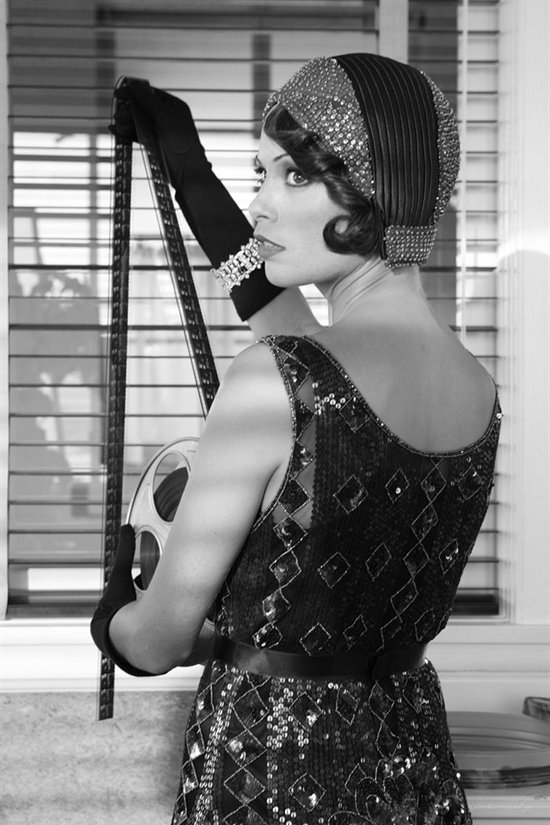 So The Artist is not a silent movie and has mostly superficial reference to the genre. Instead, it’s a contemporary film that is experimenting with sound and using the historical setting of the transition between silent and sound movies as its setting and theme. The movie plays with the soundtrack throughout, going totally mute as we’re watching a delighted audience applaud at one point – an action that would have had soaring music in a real silent movie – and containing sounds like that of a glass bottle chinking as it touches a table in a dream sequence. When we don’t have music, we have a loud hissing present to remind us that there’s no other sound. We soon realize in The Artist that sound is important to contemporary film.
Another strong aspect of the film for me is its art direction and cinematography. The décor moves from 20s silent to 30s talkie as we see furniture, accessories and costumes change. And every image in this 1:33 frame ratio is bathed in even, three-point lighting that highlights our principals while letting the eye take in every in the full frame. Jewelry sparkles here in soft focus. Even the make-up is effective at recreating period cinema. Peppy has huge eyes that are accented with liner, and she looks like Betty Boop when she cuts a view to the side; George has a strong nose that gets occasional backlight accent, and his hair is gelled down and swept over. And we get to see the actors in close-up black-and-white. The Artist is a beautiful film that’s a great homage to the films of the late 20s-early 30s.
The two main actors are also engaging. George owns the camera when he’s in front of it, capturing our attention with his strong eyes and physicality. Peppy, too, communicates strongly with her expressive eyes and her lithe agility. The two take us through every nuance of their thought as they move through the story and certainly seem to tap into acting style of the silent era.
 The Artist is a fun, and brave, film about sound. It highlights sound throughout, as a gag at the end highlights. As the film approaches it's conclusion, we see a gun, then an inter-title with “BANG!” on it. Of course we see believe the gun has fired, but the next image is of a car crash. We grin as we realize the "bang!" is the car and not the gun, and the gag again highlights how The Artist, rather than being a silent film, is actually one that highlights how sound works. Such a joke couldn't exist in a sound film. And what are we to make of the end of The Artist when we begin to get diagetic sound and discover that George has a very heavy French accent? Again, the lack of sound has enabled the movie to communicate in a way that a talking film couldn’t; we’d have known George’s national origin right away in a sound film, and we’d have known why he didn’t welcome the arrival of talkies, but silence gives us a different film and a different character.
Saturday, January 14, 2012
January 14: The Spy who Came in from the Cold (1965 -- Martin Ritt)

★★★★
After Tinker, Tailor, I wanted to watch the 45-year-old Spy Who Came in From the Cold. And I’m glad I did. It’s good.
There’s some continuity to these two Le Carre adaptations. The atmosphere and mood are similar since both have an oppressive darkness to them. While the desaturation in Tinker, Tailor sets it’s mood, a perpetual, omnipresent rain creates a feeling of bleakness in the black-and-white Spy . And there’s a tawdriness in both, too, with Alec Leamas being a drunk who makes ethnic slurs, feels sorry for himself, and works in a tedious job reshelving books. He runs up a tab he never pays at his local grocer and spends his money on alcohol, and we follow him though the unemployment line. Even his co-worker lives in a tiny apartment devoid of grace or elegance. Neither the London of the film nor its characters provide much uplift to viewers.
The storytelling here prefigures that in Tinker, Tailor, too. We don’t get a clear, straightforward story in Spy but rather have to read between the lines until the gaps are filled in. The most obvious example of this is early in the film when Control tells Alec he wants him to stay in the cold a bit longer, to remain in the Circus, solitary and disconnected from any special relationships. We soon see Alec drinking too much, looking for work, being bitter and assaulting his grocer. The film doesn’t tell us how these two situations are related until much later when we hear that Alec is trying to draw the attention of German espionage. Tinker, Tailor has similar gaps – and many more of them -- but the director of this film feels the need to fill in his 1961 audience with a few more connections. Despite Ritt’s feeling that he has to complete the story for his audience, he leaves enough jumps in the story to make the audience engage to figure out what’s happening before he ultimately give it to them as exposition.
Among the many good qualities of the film, my favorite is its bravura camera work, cinematography that the later film doesn’t match. There’s a long crane shot in the opening of Spy that hearkens back to Touch of Evil (released only three years before) as Ritt’s camera follows a car as it exits the border control at the Russian sector of Berlin and comes to the American Checkpoint Charlie. The Orson Welles reference is so explicit here that I half expected the car to explode. Another outstanding piece of camera work occurs as Alec is released from jail. The camera is inside a bus, and we see him with Nan, who the camera follows as she walks in front of the bus and runs up the side to the door and inside. And while we watch this shot, a face in the crowd stand out that we’ll soon get to know much better. It’s a camera tour-de-force.

It’s probably worth noting, too, that the gay characters come off better in the more recent Tinker, Tailor than in this film. Here, we get the impression that the man outside the prison might have been cruising to try to pick up recently-released convicts. Soon, he’s peremptorily dismissed from an important conversation and meekly, effeminately withdraws, being called queer by Alec. He couldn’t be a bigger contrast to the gay men in Tinker Tailor, who figure in the center of the plot and have well-rounded, sympathetic personalities. Forty-five years has made a big difference in the portrayal of gay characters in these Le Carre films.
I see many ways that The Spy who Came in From the Cold prefigures Tinker, Tailor, and the earlier film actually has better camera work than the later. Both, though, create an effective, dark mood and communicate a pessimism about humanity that impresses.
Friday, January 13, 2012
January 13: Tinker Tailor Soldier Spy (2011 -- Tomas Alfredson)

In a holiday season that’s seemed full of pretty pedestrian stuff, it was good to come across Tinker Tailor Soldier Spy. There’s real cinema value here.
The big thing I liked was the contrast-y image that was also desaturated. There aren’t any strong colors here; blues are flat, reds are flat and yellows are flat. Skin is ashen throughout, too, and the faces, particularly of the older characters, are heavily creased, in part because of the contrast in the film. Filmed with this look, offices are full of dirty, old clutter and dusty air, parties have a lifeless formality about them, and even Paris looks plain and drab. Tinker Tailor has this beautiful, consistent look throughout.
 The look is a visual analog to the themes of this dark film, too. The good ole days of espionage are past at this point, and there is a significant leak in British intelligence. Like the offices full of faded souvenirs of past glories, the aging characters of the film have to trace back through their pasts for clues to today’s problems. And as blue isn’t really blue here, so are friends not really friends, patriots not really patriots, love isn’t love and glory isn’t glory. Tinker Tailor isn’t black and white at all; it’s a lot of empty tones telling the story of empty values.
There’s continuity between the other film I know by director Tomas Alfredson, Let the Right One In and Tinker Tailor. They’re both visually muted, and they’re both about muted characters. The secondary characters in Let the Right One In remind me of the characters in this film – common, tawdry, mostly-good-intentioned-but-not-really-good people. Alfredson has done an excellent job of carrying the brown mood from Let the Right One In into Tinker Tailor, and the mood works great here.
And of course, John LeCarre’s book provides the story and characters. The story is long and somewhat complicated, but I credit Alfredson’s direction in keeping a lot of characters in front of us and still helping us to keep them all straight and follow what they’re doing. And Tinker Tailor would have clearly lagged did Alfredson not use such deft editing that we always only get the information we need without a lot of backfill.
It’s a bleak story. Lovers are split up, people who aren’t in love reunite, treason kills and deception reigns. But Tinker Tailor is as elegant a portrayal of exhaustion and decay as you’re going to see in a while.

Thursday, January 12, 2012
January 12: Design for Living (1933 -- Ernst Lubitsch)

This film is a total delight.
Every adjective I associate with Lubitsch comes to mind to describe Design for Living – witty, urbane, sophisticated, daring, tasteful, clever, sexy, playful, human – and every one is absolutely appropriate. it's my favorite Lubitsch film. It has a relationship triangle at its base like I’ve seen in many of his films, and the three sides of it are beautiful, funny and sincere characters. Miriam Hopkins plays an energetic, grounded Gilda who loves two men and marries a third when relations between her and the other two become too complicated. Fredric March’s Tom is one of the Americans that Gilda loves; he’s a smart, somewhat sophisticated young playwright. The third character, George, is played by Gary Cooper as a plainer American – tall, physical, and hugely sexy. I’d never seen this Gary Cooper and was surprised at his onscreen sensuality. Gilda balances herself between these two men, guiding the relationship among them with wit, charm and sex. So centered is Design for Living on this triangle that the credits even use the triangle as a motif.

Yet among all the verbal interplay and wit, there are serious emotions at stake. Gilda genuinely loves George and eventually breaks their no-sex vow to settle with him. George, for his part, deeply loves Gilda, too, and comes to count on her as they set up their household and experience George’s painting begin to take off. Unfortunately, Gilda also has a deep love for Tom, and as soon as he returns from England, she feels her love for him rekindle and decides they have to tell George they plan to move in together. She loves both, and complicating the love between Gilda and the men is the fact that the men have a deep bond also. While Tom has been in London, George has kept as a memento the old typewriter that Tom used, a visual symbol of their affection. The relationship among the three is thus a triangle, and they are bound together with real love, which raises the stakes each time their balance is shaken.
Design for Living also manages some gentle, if pointed, satire directed at capitalism and the moneyed class. As Gilda manages her two men, she steadily advises them to avoid selling out for money, and George specifically avoids taking a commission from a woman with a double chin. However, it is the hapless Max who most fully embodies these values as he constantly frets about pleasing potential advertising clients like cement makers. And not only is his personality profoundly practical if not mercenary, but compared to the young, creative trio, he is sexually impotent. After Gilda decides she can’t function loving both George and Tom, she finally agrees to Max’s persistent proposals and marries him to get away from the stress of loving the other two. The wedding flower that the two send, two drooping tulip stems, is unmistakably phallic, and Max’s anger at the flowers after his wedding night certainly suggests frustration at the two tulips. Design for Living has a good deal of criticism and satire of wealth and commerce.
 |
| “…unfortunately, I’m no gentleman.” |
The character of Gilda is another interesting aspect of the film. Women are often strong if not central to Lubitsch films, and that is doubly true here. Gilda controls and directs the two American boyfriends, determining their actions by hers. She sets the rules of their relationship (“no sex”) and decides when to break the rules (“…unfortunately, I’m no gentleman.”). She’s the agent behind the success of both of them. She holds Max away until she decides to marry him, and when she’s ready to leave him, she does so. She is comfortably with her own sexuality, choosing her partners at will. And she’s the one who, at the end, kisses both men on the lips, implying that the earlier “no sex” rule isn’t going to be in effect after the three begin their new, more mature triangular relationship. Gilda is the powerful female center to this film.
Design for Living is fun, light, witty and uplifting. Its openness and positive view of human nature is infectious, and it’s a movie that can stand up under multiple viewings. As I’m sure will be the case for me.
Wednesday, January 11, 2012
January 11: The Wildcat/Die Bergkatze (1921 -- Ernst Lubitsch)

★★★
Wildcat tends more to the broad, slapstick side of comedy than some of Lubitsch’s other works from this time, but there are some sly asides of understated humor and some plot devices that are typical of what I expect from Lubitsch. It’s got a lot of irony that’s memorable, and you’d have to put the film in the grand old tradition of anti-military films.
You get the broad side of Wildcat’s humor in the opening scenes. There are some silly idiosyncrasies among the troops who are asleep and obvious stunts when the bugler sounds reveille. It's all pretty flat. When the Kommandant comes in, everyone quickly becomes soldierly, but as soon as he leaves, they all jump right back in bed. This is vaudeville -- not even clever vaudeville -- and it’s off-putting so early in the film. The large gestures continue throughout, but they get a little funnier. As lady’s man Leutnant Alexis leaves for his new post, there is a crowd of hundreds of women to say good-bye at the ceremony, and the crowd cries and blows its nose in sync as part of the departure. The army can’t control the ensuing women's riot as the hundreds of women overwhelm military security. And in the vast sections of crowd crying and cheering as the Leutnant passes, there’s a huge section for his offspring. That little touch is broad but at least witty. In another scene, Rischka sets out in the snow across the mountains in despair of marrying the Leutnant while the Leutnant himself, in despair over his forced marriage, decides to jump into the snow and slide down the side of the mountain. They run into each other. That coincidence is so unlikely that it’s just funny. Such wit cushions the time we spend on underwear jokes.

All the humor in Wildcat isn’t so clearly in-your-face; there are very funny, ironic touches throughout the film that you have to pay attention to or miss. I hardly noticed, for example, that when the army detail goes punish the bandits, the military band is at least double the size of the troop of soldiers. The soldiers fight with snowballs and stumble on ice, but in all that broad comedy, there’s the understate wit of the respective group numbers, too. The art direction also brings a level of subtle irony to the film. In the fort, every window has an oversized canon wedged into it (ringed in white trim), and the interiors are heavy, massive curves used as furniture. A sad Leutnant rocks on one of these while seeking consolation in the bottle, looking for all the world like a kid on a rocking horse. Even the bandits’ environment has cute décor touches – everything bandit has a childlike skull-and-crossbones on it. The actors, too, add many small comic asides to their performances. When Pola Negri’s barbarian leader Rischka is splashing toilet water on herself in the fortress raid, she accidently dumps some down the front of her blouse and goes through a rapid series of facial changes that’s as funny as it can be. And easy to miss. The many subtle touches here give Wildcat a nuance that the Three Stooges never get.
One last thing I like in this film is the character of Rischka. She is the wildcat, and she’s a force of nature. She runs the bandit band, bossing and terrorizing all its members. She scares everyone into submission when they start to beat up their chief, who is her father, and she leads the defense against the military incursion, telling her father to fix the coffee while she does so. And he brings her coffee to her in the field. She’s the one who dumps her fellow drunk raiders onto a sled when they leave the fortress, too. She is quite a powerful female figure.
After all this Lubitsch, I’m also noticing that he uses love triangles to propel his plot. Here, you have Rischka—Leutnant—Kommandant’s daughter as well as Rischka—Leutnant—Bandit. A lot of the action is centered on these triangles, just as it is in other films like Sumurun, Anna Bolyn and The Oyster Princess. It’s a structure I’ll have to look for in further Lubitsch.
Wildcat has many interesting sides, and I have to say I enjoyed watching it. I wish it had had more wit and less vaudeville, but it’s nuances can make it well worth the time.
Subscribe to:
Posts (Atom)