Wednesday, December 4, 2013

December 4: Abraham Lincoln (1930 -- D.W. Griffith)

★★

There is some fun flair in Abraham Lincoln, but there isn't enough to redeem the film from its terrible script and the stilted acting.  From the love scenes through the public oratory and presidential decision-making, the language is poetic and the delivery, declamatory.  As Lou said, this film is a silent movie with sound.

It features Griffith using techniques that were innovative fifteen years earlier but old hat by this time.  There’s cross-cutting, which Birth of a Nation skillfully exploited in 1915; here, Griffith uses the same technique and for the same purpose, to contrast the North and the South and to show simultaneous action.  Lincoln also shows us extras-packed war scenes reminiscent of both Birth and Intolerance, and dissolves between scenes here suggest that the content of one shot lingers into the next.  For example, Lincoln’s distress at the death of Ann Rutledge dissolves into his virtual breakdown afterwards.  There’s also the technique of using a repeated image to convey a poetic meaning.  Intolerance repeatedly returns to the rocking cradle; here, we keep seeing a tracking shot of a landscape model, an image the film offers as symbolic.  And close-ups here lend intimacy and urgency, just as they did in Birth, Intolerance and Way Down East.  Whether it’s Lincoln’s seduction of Ann or the facial intensity of rebels plotting the assassination, close-ups of the actors’ faces bring us into the emotion of the scene.

Griffith adds at least one new element to some close-ups Lincoln that shows his direction hasn't completely ossified.  In a very contemporary and unexpected way, Griffith sometimes has his actors, in close-up, look directly at the camera and at us.  Our introduction to John Wilkes Booth has one such moment in it, which drives home to us the radical he is; likewise, Lincoln tells us at one point, eye to eye, that the Union will not be dissolved.  Such breaking the fourth wall shows a director at least modestly looking to vary his cinematic language.

Griffith also integrates camera movement especially well with the rhythm of a scene in this film.  At one point, the camera moves in on wedge Lincoln is using to split wood and then draws back to show us Ann watching Abe as he splits logs.  Then the camera moves in for their intimate dialog before it ultimately cuts to dialog with Abe’s employer.  This is a much more fluid camera than we see in early Griffith.  The scene of Abe’s proposal to Ann is even more lyrical and fluid.  As the scene opens, the camera follows a singing shepherdess walking a cow out through the pasture.  The camera then swings back across the field to close in on Abe’s proposal.  After Ann accepts, the camera swings back to the shepherd girl, who is just closing the gate and coming to the end of her song.  It’s a beautifully-edited sequence, a culmination of techniques Griffith used earlier.

There’s even a moment of German Expressionism in Abraham Lincoln.  Late in the film, a backlit Lincoln wearing a tall top hat descends narrow stairs toward the viewer with a child at each hand, a shot which carries an eeriness that doesn't appear in other Griffith work.  Here, the director is clearly trying out alternative ways of telling stories.

Unfortunately, for all the innovations big and small, Abraham Lincoln doesn’t engage an audience because its dialog is so literary and its acting so stiff and stagy.  It can have striking moments of historical accuracy, like the scene that shows the horse and buggy dirtied up with mud, but in cinema, Griffith had clearly done better work previously.


Tuesday, December 3, 2013

December 3: Way Down East (1920 -- D.W. Griffith)

★★★★★

The first whiff of sentimentality or melodrama can take me out of a movie fast; I moaned aloud at the big reveal in Gravity, which broke the spell of even those effects.  But when Lillian Gish learns she isn't actually married in Way Down East, I’m hurt and angry.  And when she’s wandering homeless and sees the happy Bartlett family in their home, I long for her to join them just like she does.  Gish’s performance in this film is a master class in silent acting, in understanding and collaborating with the camera in a way that sucks a viewer in.  Her posture, her timing, her facial expressions, her gestures – all these are hugely emotive.  For an audience that can suspend current cinematic values enough to allow the silent’s, Way Down East is a remarkably affective film.

An easy way for a modern audience to engage Way Down East is through the character of Gish’s Anna.  She’s a little simpler and far more innocent than we can believe today, but her wisdom and power grow dramatically in the film.  After learning she’s been deceived about her marriage, she vows to marshal on as a single mother, and when her newborn is ill and she fears for the unbaptized child’s eternal soul, Anna usurps clerical prerogative and baptizes her child herself, an act that would bring a good deal of condemnation even in today’s cinema.  Not long afterwards, Anna defies class conventions and refuses to leave her home with the Bartletts despite being ordered to do so by the upper-class Sanderson.  And she takes a feminist stance when she complains that an unwed mother is ostracized but the father of the child is embraced.  Way Down East may be approaching the century mark, but Anna is a common-sense feminist that can inspire us today.

Several Griffith film techniques are on clear display here, too.  Early in the film, we’re already seeing sentimental symbolism as we watch the young Bartlett longing for love while surrounded by baby birds and blossoms.  As Bartlett later courts Anna, Griffith sets the couple in the lower left of a pastoral scene.  The scene of Bartlett’s longing also points to another technique that Griffith uses often, the close-up.  Griffith mastered the art of filling the frame with actors’ faces to bring viewers into the action and into the personal struggles of the characters.  In this scene, Richard Barthelmess overplays Bartlett’s longing, but Griffith’s use of close-up for effect remains a good decision.  The director also uses the tracking shot on Way Down East that he’d found so worthwhile in his two previous features.  At one point, for example, his camera tracks Martha as she rushes back to the Bartlett’s bringing news of Anna’s deceit.


While all of these elements are familiar, the tried-and-true Griffith technique that gets the most attention here is cross-cutting.  Like in his other films, Griffith uses this technique to build suspense.  Much of the suspense in the famous ice floe scene come from the film alternating between showing us the rescuer and cutting to the heroine.  More suspense is created as Martha is rushing home to denounce Anna and Griffith cuts back and forth between Martha and Bartlett’s effort to propose.  As this scene also implies, Griffith’s cross-cutting can elicit irony.  While Bartlett is at home longing for a mate, the film cuts back and forth from him to the false marriage that Sanderson has set up.  Way Down East shows Griffith refining the number of things he can do with cross-cutting.

Like many silents, Way Down East also uses the vocabulary of melodrama.  Anna trials are textbook examples of the extreme situations and heightened emotions that govern this style.  Anna is deceived by the evil Sanderson and bears an illegitimate child.  Her mother dies, and the new mother is cast out penniless.  The child then dies.  And just when Anna is beginning to recover, her secret past is revealed, and she finds herself cast out yet again.  The film’s story uses such heightened exaggeration to engage its audience.  And in addition to the melodrama, Way Down East relies on stereotypical characters like the spinster gossip and the comic, plain-faced country people.  Elements such as these are no better or worse that those found in other films of the era, though Gish’s ability to play to the camera hooks us into this melodrama.

Of course, the ending of the film is rightly famous.  Attention is generally focused on the ice floe rescue during which actor Richard Barthelmess actually leaps from ice sheet to ice sheet to get to Lilian Gish, herself floating down the river towards a waterfall on a piece of ice.  However, the prior scenes of Anna running through the winter storm in anguish at this final reversal in her life are equally gripping.  During this segment, we see images of bare branches that are intercut with Anna’s bent, clutching hands and arms in the air, and the film then cuts to a ghoulish image of the devastated woman’s face, eyelashes tinged with frost.  And all of these on film stock tinted purple.  It’s as creepy a sequence as anything Murnau would create.

In Way Down East, Griffith tells a straightforward melodramatic story using the cinematic language he had played such a key role in developing.  His collaboration with Lillian Gish gives this film the lift that puts it at the top of silent drama.

Sunday, December 1, 2013

December 1: Intolerance: Love's Struggle Throughout the Ages (1916 -- D.W. Griffith)

★★★★★

The word to describe Intolerance is “scale.”  Nothing here is modest or subtle.  Rather than one story, this one has four, and they’re not only spread over thousands of years but they’re weighty subjects like the fall of Babylon to the Persians, the massacre of the Huguenots by Catherine de Medici’s Catholics, and the life of Jesus Christ.  It’s hard not to admire Griffith’s ability to even imagine such a project, not to mention actually setting out to accomplish it.

Griffith’s ambition here doesn't stop at his choice of subject matter; what he puts on screen is every bit as impressive to look at.  His contemporary tale of the poor who are oppressed by capitalism and by self-righteous Reformers still manages to open with an opulent ball and elaborate costumes.  Likewise, the depiction of Charles IX’s France has some lavish royal sets and decoration as well as scenes filled with running crowds and soldiers surging from one side of the screen to the other.  The crowds appear, too, as Jesus struggles to Golgotha with the cross.  But it’s in the Babylonian story that Griffith goes all out for spectacle in Intolerance.  Thousands of extras dance on an elevated courtyard surrounded by undulating pillars that rise several stories from carved bases and end in large elephants.  In the interiors, Babylonians wear elaborate costumes, jewelry and make-up, and the battle scenes are replete with siege towers, basins of burning oil, and hundreds of soldiers scaling walls and being repulsed.  At one point, the camera itself takes wing, perhaps mounted in on early dolly, as it photographs a Babylonian performance.  The whole movie is visual extravaganza.

Griffith, too, ups the editing ante in Intolerance.  The previous year’s Birth of a Nation had clearly shown the power of cross-cutting to create suspense, and Griffith was quick to apply that lesson in Intolerance.  In the contemporary story, he cross-cuts scenes of the execution with scenes of the rush to get exculpatory evidence to the prison, for good measure tossing in a racing scene and a few impediments to the car carrying the evidence.  There is similar use of this editing technique in the Babylonian and the French stories as characters rush to warn others of the imminent threat bearing down on their respective beloveds.  But Griffith amplifies this technique of building suspense by cross-cutting beyond what he accomplished in Birth of a Nation because he cuts between the stories as he cross-cuts within each story.  Thus, the story of the Mountain Girl rushing to warn Belshazzar is cross-cut with the story of Prosper Latour rushing to warn Brown Eyes.  And this intercutting of stories builds suspense in a way impossible in the one story of Birth of a Nation because both the Mountain Girl and Prosper fail to save the object of their affection, suggesting that The Dear One might, too, fail to save The Boy.  With four storylines to play with, Griffith ramps up the suspense in Intolerance exponentially over that in Birth of a Nation.

All of which is not to say there are no problems with this early spectacle.  One of the biggest drawbacks is the muddled point of all the excess and suspense.  Only three of the stories in fact deal with intolerance – the Modern, the French, and Jesus’ – while intolerance doesn't seem to be an issue in the Babylonian.  And if we consider the subtitle, “Love's Struggle Throughout the Ages,” we only cover the Modern, the French and the Babylonian because we don’t find love as an element of the Jesus story.  And the film's odd ending of the peaceful soldiers, the angels and the divine light hardly seems appropriate to the stories we've seen either, especially given their tenuous thematic links.   Likewise, the woman rocking the cradle, the image idée fixe of the film, doesn't have a clear significance.  With the large time span of the stories, there’s no real reason to affirm the universality of Intolerance’s themes, as some maintain the image does.

Intolerance also suffers from expressing some of Griffith’s own intolerance.  The meddling do-gooders in the modern story come in for special scorn with their hypocrisy and their coldness.  With their holier-than-thou attitude, they take away The Dear One’s baby to turn over to irresponsible handlers; in fact, it’s the do-gooders’ need for more money that motivates the factory owner to squeeze his workers until they all strike and end up unemployed in the city.  Elements of the other four storylines imply criticism of these same women.  Jesus criticizes the public piety of the Pharisees, forgives a prostitute, and even makes wine; all these actions fly in the face of the values and practices of the modern do-gooders.  In the French story, religion is primarily a weapon, another indictment of religious people, and the sympathetic couple of the Babylon story are hedonistic lovers who aren't married.  If there is any unity among the four stories, it’s a shared critique of do-gooders and their manifestations in various ages.

Intolerance is a sprawling film of great excess, and it’s hard not to get caught up in its technical achievement and thematic grasp.  The film is far from perfect, but it is one of cinema’s great pleasures.


Saturday, November 30, 2013

November 30: Birth of a Nation (1915 -- D.W. Griffith)

★★★★

When a film can have you rooting for the Ku Klux Klan to rescue a group of white folks from a black military unit, you have to pay attention to what’s been happening on the screen. And when that film is from 1915, there’s even more cause.  The paradox of the repugnant racism which informs Birth of a Nation and the aesthetic beauty and technical achievement of the film puts it on a very short list of movies that make me uncomfortable to watch.  In a bad way.  Like the anti-gay bigotry of Rome, Open City and the aesthetic idealization of fascism in Triumph of the Will, the pervasive racism in Birth of a Nation makes watching the film today an ambivalent experience for me at best.

Birth of a Nation isn’t overtly hostile to its black characters, but it sees them from a condescending, paternalist perspective.  The black population in the film dances barefoot, plays music, laughs and eats chicken and watermelon, but the people themselves aren't portrayed as inherently anti-white.  Much of the black/white tension in the film results from Northern whites manipulating the simple-minded blacks, though there is some resentment of whites in characters such as Stoneman’s housekeeper.  Another element of the bigotry here is that some black men, like Silas and Gus, are unable to control their passion for white women, which leads to conflict.  There aren't any workable interracial love interests here.  And though Birth of a Nation includes some positive positive black figures, these characters embody the paternalistic attitude of the film in their own way -- Mammy and Jake are contented servants willing to give their all for their white owners/employers.  Because of the paternalism in Birth of a Nation, the black characters don’t hate whites and don’t especially want to dominate them; instead, the African Americans here aren’t able to think for themselves and mostly take their cues from white ideologues who are bent on using them to upend social convention.

A striking thing about Griffith’s paternalistic racism is that it doesn't imply that blacks need to be repressed.  Birth of a Nation lauds Abraham Lincoln and approves of his leadership in the Civil War and his freeing of the slaves in the South.  It goes on to show Lincoln as trying to ease the reintegration of the South into the Union against hardcore ideologues like Stoneman and opportunistic carpetbaggers.  It’s these latter parties, who manipulate the black population to their own advantage, that are the real villains in this film.  African Americans are too simple to be responsible.

But aside from the racism that informs Birth of a Nation, the film is clearly a giant step in film narration. 
E.W. Porter may have pioneered basic elements of modern film like simultaneous story lines and continuity editing, but it’s Griffith – here – who turns these elements into what feels much like the language of cinema as we still know it today.  

Early in Birth of a Nation, editing lays out simultaneous stories as we visit the Stoneman family of Pennsylvania and the Camerons of the Piedmont.  The simultaneity here contrasts life in the North and the South.  After the war begins, Birth of a Nation also cuts between battlefield and home front, showing us what’s happening in those two spheres.  But the real conceptual leap in this film is its suspenseful conclusion as we see the Klan rallying, Lynch trying to force Elsie into marriage, and the Camerons being surrounded by a menacing black militia.  All simultaneously.  And Griffith doesn’t grant the audience narrative relief until all three narratives are resolved.  We worry as the Klan gathers, wondering if the riders will be in time to rescue Elsie, but then while the rescue of Elsie is underway, we worry whether Ben will get the Klan to the countryside cottage to rescue the Camerons.  It’s this headlong narrative drive that so engages viewers today that causes us to end up rooting for, of all things, the Ku Klux Klan; this section of Birth of a Nation is a real testimony to the power of the film language that Griffith masters here.

Modern viewers also recognize other cinema elements in the film that are familiar to us.  For example, Griffith uses editing to portray a psychological state of mind.  At one point, Margaret rejects a suitor as she thinks back on her brother, and the director cuts from a shot of Margaret thinking to one of her brother dying.  This edit evokes not only the brother’s death but Margaret’s pain over losing him and establishes her state of mind.  And Griffith uses many now-standard cinema gestures to create the scale and kinetic energy of a battlefield.  A shot of a woman with her children morphs into the introduction of a huge battle as the camera pans from a medium close-up of the family unit on a hill and to a very long shot that reveals a massive military assembly in the valley below.  Later, a matte insert combines scenes of Atlanta burning with frenetic battlefield movement in the foreground to create an onscreen battle that not only forecasts the same one in Gone with the Wind but also the large-scale SFX work in movies like the Lord of the Rings trilogy.  Birth of a Nation uses such cinematic elements to put scale on the screen, but within such large-scale views, individual vignettes give us the human element of war.  The young Cameron and Stoneman die together in battle, a scene anticipating the melodrama that silent film would embrace so firmly, and there’s even a tracking shot of the Little Colonel leading a charge that is shot from the open bed of a truck ahead of the action. 

The 1915, Birth of a Nation also anticipates other features that would become cinematic stock-in-trade. 
There is the engaging humor in the way the guard at the hospital pines for Nurse Elsie.  His cute if futile gestures prefigure the Little Tramp as well as Buster Keaton.  And we have a full blown action hero in the sexy, shirtless blacksmith who fights off everyone in saloon.  It’s moving take on the action hero because, unlike today’s massive strongman hero, this one is ultimately shot in the back and killed, adding to our anger at the bad guys.  It’s hard to imagine a similar end to a Bruce Willis or Jason Statham character.  And Griffith even anticipates John Ford and David Lean in this film.  The brief shot of a silhouette of horsemen on a hill could have been shot in Monument Valley or Wadi Rum decades later. 

And I’m no expert, but I found the use of intertitles in the film to be inconsistent and, for that reason, interesting.  Some of them summarize and comment on the action we've seen, and others give dialogue.  Among the most interesting are the ones aimed to shore up the verisimilitude of the film.  Some explain that the way we see Ford’s Theater is the way it really was or that the tableau we see of the surrender at Appomattox is an honest rendition of the historical fact, complete with footnotes and references to sources.  Beyond the intertitles, Griffith also aims at being “realistic” by basing some scenes on Civil War photographs.  The image of the rider on the black horse with a wagon in the background echoes an image of Mathew Brady as do the images of battlefield causalities.  

All of which takes a viewer back to the uncomfortable paradox of this film -- the combination of its terrible racism with its breakthough discovery of powerful film language.  Birth of a Nation is certainly one of the most difficult films films for a viewer to know how to respond to.

Wednesday, November 27, 2013

November 27: Inception (2010 -- Christopher Nolan)

★★★

The central problem with Inception is that it's too complicated to be a movie, even a 2-1/2 hour movie.  That’s why we have the constant exposition of rules and amendments to them.  If we all knew we’d wake up if we were killed in a dream, that wouldn’t need explaining.  And we wouldn’t need to find out later that if we were dreaming under sedation and were killed in a dream that we’d wash up on the shores of our unconscious and our consciousness would be a mush.  But we don’t know that, so someone has to explain it.  And they have to explain what a “kick” is, why we shouldn’t use memories in a dream and whose projections hate whom and why.  And then there are the corporate and family connections that figure in the film.  And the technique for incepting an idea.  There is just way too much explaining in this movie.

There is also too little heart.  The most complex character, Cobb, is a string of adjectives – lovelorn, hurt, guilty, manipulative – but despite DiCaprio’s best efforts, there’s not enough time amid all the exposition to connect these parts into a cohesive personality.  And the other characters are mono-dimensional.  Adding to character weakness, Ellen Page, with one of the main roles in the film, is completely unable to commit to Ariadne and delivers her lines in precisely the same way regardless of the dramatic circumstances.  With so much exposition and so little sympathetic engagement, Inception doesn’t have a lot of options for audience appeal.

But it uses the remaining options very effectively.  For one, what Nolan can’t do with characters he does well with plot.  Like in Following and Memento, the plot of Inception is broken into parts and reassembled with a cleverness that draws us in.  To perform the inception, Cobb designs an intricate, three-level operation with the actions on one level being important to the actions on the others; time in all the levels is related.  And we even get a bonus level at one point.  Inception has something of a geek appeal in the way all the levels cohere, but they cohere with a satisfying consistency.

 There are fun visuals in the film, too.  Action sequences are effective and logical.  Chases like the one on foot though Mombasa and the one with cars and a train have lots of dynamism and surprise, and the James Bond-ish snow fight is particularly easy to follow.  Nolan complements these with great special effects.  Arthur’s fight in the free-fall hotel corridor is the central action sequence of the film as the fight occurs on floor, walls and ceiling, but the slow-motion plummet of the truck, too, has fun visuals.  Likewise the scene of Ariadne learning what she can do in a dream by folding Paris up and creating bridges and mirrors at will.  And all these aside, there are fun images like the bullet train speeding across a marsh or the elaborate décor of the Japanese palace that opens the film.  Nolan is at his most effective at technical feats like these.

Like much of Nolan’s work, Inception excels at the mechanics of an action movie.  Its plot is like a well-oiled machine, and technical elements like special effects and action hum.  There’s even the clever use of “Je ne regrette rien,” a cute nod to Marion Cotillard’s role here.  But someone should have reined in Nolan’s elaborate world and the complicated, unfamiliar rules that needed so much exposition.  And added a bit of heart.  Inception is fun, but it could have been much more.

Sunday, November 24, 2013

November 24: Following (1998 -- Christopher Nolan)

★★★★

This is a surprisingly fun little film, enjoyable in its own right and and a pleasure to see from our vantage point now much further into Nolan’s career. The director’s first outing, Following is a film shot in black-and-white and complete with a dark mood, pervasive corruption, high-key lighting and a femme fatale in the person of the Blonde.  It also borrows the trope of starting with a cop interrogating our main character, and as is often the case in this genre, the hero doesn't fare well in the film.  It’s easy to see Following’s film noir roots.

None of this is very far from The Dark Knight Rises.  Not completely black-and-white, the later film is nonetheless often monochrome, and there’s clearly the same oppressive dark mood in both, even heightened in Following.  There’s also a fair amount of darkness and contrast lighting in Dark Knight Rises, and it has both a penitent and a full-blown femme fatale in Catwoman and Miranda Tate, respectively.  The correspondences are uncanny; without seeing Following, I wouldn't have picked up on the film noir elements in The Dark Knight Rises.

Yet watching Following is more fun than watching Nolan’s latest Batman.  Following is taunt and its elements, purposeful; in fact, in the reversal at the end of the film, the viewer even reinterprets all that has come before.  Something as insignificant as signing a credit card turns out to have been important to the story, unlike the rambling in Dark Knight Rises that can dwell on elements that don’t resonate later.  Why did Bruce Wayne spend all that time in an underground prison?  There is no such sprawl in Following.  This film is economical rather than sprawling and fat; every detail, item and even gesture has purpose.

This movie also has narrative engagement and suspense, two things lacking in The Dark Knight Rises.  Nolan’s fractures the plot of Following into four periods and intercuts them for the story, but there are always clear markers to cue the viewer into the respective parts of the plot.  We find ourselves watching the film as something of a puzzle, but this story structure also engages us with questions about how these parts are connected.  Why did the Young Man get cleaned up?  How did he end up with the bruises?  This type of narrative is somewhat contrived, and though Nolan uses it just as effectively in the later Memento, it’s not technique that would bear frequent repetition.  Here, though, it pulls us into the story.

And Following has lots of squirm-inducing suspense.  The film’s basic concept of following a stranger for fun is creepy and raises fear in the audience of the consequences; the tense scene when Cobb confronts the Young Man gets its suspense from this setup.  There’s also an extremely suspenseful scene when the two break into an apartment and Cobb casually goes through the residents’ personal items, even having a glass of wine in their kitchen.  That suspense peaks when one of the residents returns home unexpectedly.  And in yet another scene, the Young Man has to tape cash to his body while in constant fear of being caught.  That scene is has an intensity lacking at any individual point in The Dark Knight Rises.

Following has originality, creativity, engagement and suspense.  Darkness pervades this little movie, but it’s a sharp, cutting darkness rather than the continuing thud of a club.  This debut makes us hope that Nolan is eventually able to make contact again with the deftness and precision of this early work.


Sunday, November 17, 2013

November 17: The Dark Knight Rises (2013 -- Christopher Nolan)

★★

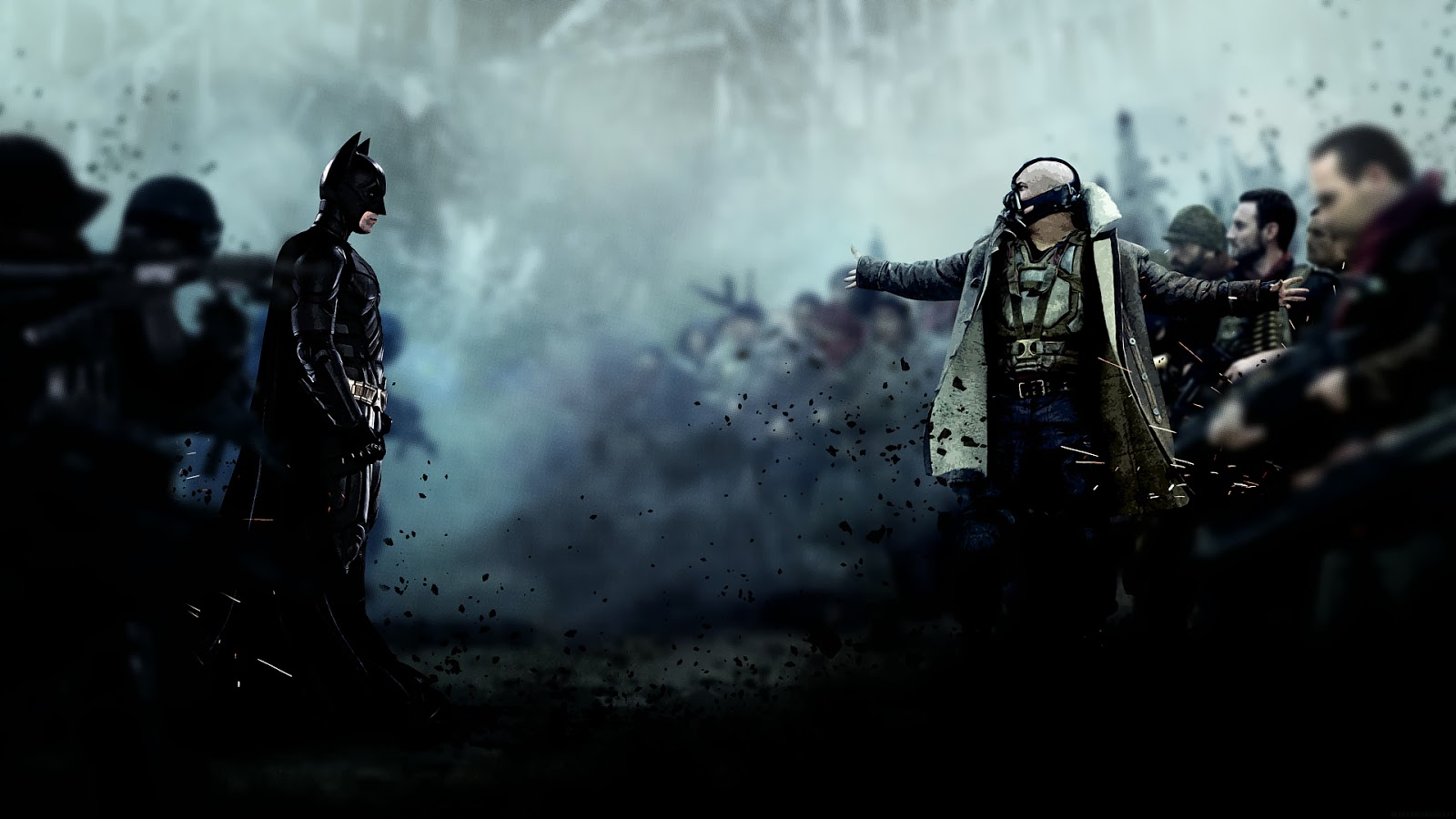
If Dostoyevsky worked for Stan Lee, we’d get something like The Dark Night Rises.  An aging, battered Bruce Wayne opens the film in seclusion, licking his wounds.  Gotham crime rebounds, and Wayne goes through mental angst to decide if he should don the cape anew.  One he decides, and with the aid of a remarkable brace, he recovers his physical agility.  However, he is soon betrayed by the woman he loves (twice), loses his entire fortune, and gets badly beaten yet again by Bane, who exiles him to an underground prison in China (or someplace similar).  By comparison, Raskolnikov didn’t have much to deal with.  And into this unrelenting stream of pain, is added the infirmity of Commissioner Gordon and the fall of Gotham City into a sort of Reign of Terror with its own Robespierre. 

Then Batman defeats the bad guys and goes to Florence for coffee with his repentant girlfriend.  I kid you not.

The Dark Night Rises is a sprawl of cinema that veers from one mood to another and from one plot point to another.  First, Batman is crushed, but comes back to win the second round.  He’s imprisoned with little explanation, and he gets back to Gotham with little explanation.  To a degree, this aesthetic is true to the Marvel source, but on the screen, it becomes long and even annoying.  And Nolan isn’t inclined to pare his story down to a more fundamental narrative focus with consistent characters and values.  When we discover that Bane isn’t the real bad guy but that Talia is, this reveal nearly takes the wind out of the story; we lose Bane’s plot energy, but Talia doesn’t have the story interest to replace him. In the first 90% of the film, Batman undergoes so much pain and loss that we might be forgiven if we eventually wish he would indeed give up the cowl so his relentless pain would ease.

But for all these unsatisfying elements of The Dark Knight Rises, there are aspects of the film that warrant note.  One of the most interesting is that Batman is a past-his-prime male who has to try to find his place in the world outside the role he’s held for so long. Dark Knight Rises gives us a superhero that isn’t as super as he used to be, who is physically vulnerable and who can be tricked.  He’s a superhero we don’t see often.  Dark Knight Rises also makes a political nod in the direction of today’s situation of a shrinking middle class and an underclass with no upward mobility.  Catwoman resents the rich in an almost Robin Hood way, and Bane’s takeover of Gotham appeals to resentment against the 10%.  But if Dark Knight Rises has a political message, it’s difficult to read it clearly.  There’s a position here against Tea Party anarchy, but there’s also a feeling that Bruce Wayne and the moneyed class manage to keep order much better than the mob rule Bane incit and manipulates.  The ideology here isn’t clear, or it’s one that many of us might not want to think about.

As with the other two installments of Batman -- and many of his other films – Nolan goes for gut moments at the expense of the overall film.  Dark Knight Rises isn’t nearly as rambling and fractured as its immediate predecessor, but it’s not a very satisfying either.